The Society of Fatigue
When Giving It Your All Isn't Enough -By Cristian Situ Sánchez- I started working during my final years of college, doing an internship in journalism. The pace was intense and relentless: tasks piling up, new responsibilities every day, and the feeling that it was never enough. I quickly learned that giving it my all didn’t guarantee recognition or relief; there was always something else to do.
When Giving It Your All Isn't Enough
-By Cristian Situ Sánchez-
I started working during my final years of college, doing an internship in journalism. The pace was intense and relentless: tasks piling up, new responsibilities every day, and the feeling that it was never enough. I quickly learned that giving it my all didn’t guarantee recognition or relief; there was always something else to do, always an unattainable standard to chase.
Then came the startups. That intense pace became overwhelming: long days, projects multiplying without any prioritization, and the implicit expectation of being available almost all the time. If you tuned out—even for just a moment—you could feel the silent judgment of your coworkers. Later, during my corporate phase, the environment changed in form but not in substance. Phrases like “you have to give 110 percent” or “put your heart into it” hung in the air, and even when I did my best, it was never enough. The promised freedom to choose turned into a mandate to maximize, and burnout became inevitable.
These experiences led me to reflect on what the South Korean philosopher Byung-Chul Han describes in his essay The Society of Fatigue (2024)*. Han argues that we live in a society characterized by an excess of positivity, the disappearance of negativity, and constant pressure to perform. Our obsession with producing and achieving has led us to an internal “heart attack,” rather than an external infection: a mental block that causes depression, burnout, and other neurological disorders.
From External Threat to Internal Exhaustion
In the past, the greatest threat to society was the “other”: the foreign, the different, the strange. Discipline and prohibition served to protect the community, and negativity—the “don’t do this”—structured social life. Today, Han argues, the threat does not come from the outside, but from within. Otherness has disappeared, and difference has replaced the strange: the other no longer unsettles us; now they are a tourist, a consumer, or a colleague. The tension generated by difference has dissipated, and with it the opportunity to confront and reflect on what challenges us.
This change marks the transition from the disciplinary society, as studied by Foucault, to the society of achievement. Before, we were governed from the outside through prohibitions and clear rules; now we govern ourselves, self-exploiting under the illusion of freedom. Every “I can” is a form of self-imposition, and the pressure to maximize becomes the norm, not the exception.
Disciplinary society was based on clear boundaries: prisons, hospitals, schools, and factories established what was allowed and what was not. Prohibitions shaped behavior and assigned roles. Achievement society, on the other hand, invites us to produce without limits. The norm no longer says “don’t do this,” but rather “yes, you can do it all”: work overtime, take on side projects, take courses, create content, and participate on social media. The result is a freedom that enslaves, a mandate for productivity disguised as autonomy.
The Freedom That Wears You Down
In a high-achievement society, every individual becomes an entrepreneur of their own life. Self-exploitation is no accident: it is at the heart of the system. We can work overtime, take on side projects, produce content, and meet personal and external expectations—all under the premise that we are free to do so. However, the freer we believe ourselves to be, the more we limit ourselves, trapped in what Han calls the “free constraint of performance”: the pressure to maximize is disguised as freedom and ends up suffocating us even more.
Added to this are external factors that intensify the strain: toxic and exploitative bosses, ill-intentioned colleagues who only seek their own gain, or people who hurt us for no apparent reason, under the classic motto, “It’s not personal—it’s business.” And yes, it’s partly true: often these dynamics stem from an unsustainable system, where behaving this way seems to be the only way to get ahead. The pressure doesn’t come solely from within ourselves; it’s also reinforced by social and workplace structures that perpetuate self-exploitation.
My experience confirms this. Whether in internships, startups, or corporate settings, the constant pressure didn’t come solely from me; I also felt the weight of an environment that rewards extreme competitiveness and absolute availability. The illusion of autonomy masked the reality: the more I could do, the more I had to do, and the more I tried to set boundaries, the more friction I created. Self-exploitation became the norm, and burnout, a silent companion.
Hyperfocus and Multitasking: Surface Replacing Depth
Byung-Chul Han analyzes how the achievement-oriented society affects our attention economy. The overabundance of stimuli leads to hyperattention, a state in which we perceive a great deal, but only superficially. Multitasking, doom scrolling, notifications, emails, messages: we react to everything without immersing ourselves in anything.
Paradoxically, this hyperactivity leads to passivity. Scattered, reactive, and nonstop action prevents us from making decisions, reflecting, and acting authentically. Each person carries an internal “work camp” that maintains constant vigilance, depleting the capacity for deep attention and contemplation—skills essential for creativity, reflection, and a fulfilling human experience.
Also important is the comparison he draws between this state and the vigilance of a wild animal: attentive to everything in the immediate moment, unable to focus on what is essential, trapped in urgency and fragmentation. Multitasking, far from representing progress, is a step backward: it prevents us from achieving the contemplative immersion that would allow us to marvel at and understand our surroundings.
Two Types of Fatigue
Here it is important to distinguish between what Han defines as “solitary weariness” and “eloquent” or “reconciling” weariness:
Lonely exhaustion is divisive, isolating; it fragments perception and destroys community. It is the exhaustion caused by self-exploitation and an obsession with performance. It disconnects us from ourselves and from others. On the other hand, meaningful exhaustion arises from meaningful or collective activity, and it allows us to regain energy, reflect, and connect. This kind of deep exhaustion is creative and restorative; it promotes social cohesion and humanity.
In recent years, I’ve learned to appreciate the restorative kind of tiredness: walking around the city, spending time with my family, and devoting time to personal projects without any external or internal pressure. These are moments when tiredness ceases to be destructive and becomes a source of meaning and renewal.
Burnout as a Social Symptom
Conditions such as depression or burnout are neither isolated individual problems nor purely biomedical issues. They are social symptoms, the result of the pressure to constantly maximize, produce, and perform. Society pushes us to become performance-driven individuals: we exploit ourselves, believing we are free, but in reality we are trapped in an endless cycle of productivity.
This phenomenon has profound consequences: it affects creativity, weakens the community, destroys deep perception, and fragments everyday experience. Fatigue isn’t just physical—it’s mental, emotional, and social. And we often ignore it because contemporary culture celebrates efficiency and the ability to do a lot, even when we do it poorly or superficially.
Toward a Sustainable Lifestyle
The "fatigue society" is not just a diagnosis—it is a challenge. It invites us to question how we measure success, how we work, what expectations we place on ourselves, and how we relate to our time. In a world that celebrates infinite productivity, slowing down is not a weakness—it is an act of resistance.
My personal transition taught me that fatigue isn’t just an individual issue—it’s structural. Society pushes us to be more, give more, and produce more. Only by understanding this fatigue can we imagine another way of living: one that is more mindful, balanced, and humane. Learning to listen, rest, and set boundaries is not a luxury; it is an act of self-care and a way to reclaim what excessive positivity has taken from us.
In a world where everything must be possible and nothing is ever enough, taking a break allows us to rediscover meaning, connection, and freedom. Only then can we hope to live without being consumed by our performance-driven society and build a life worth living.
*This is the 4th edition of the essay.
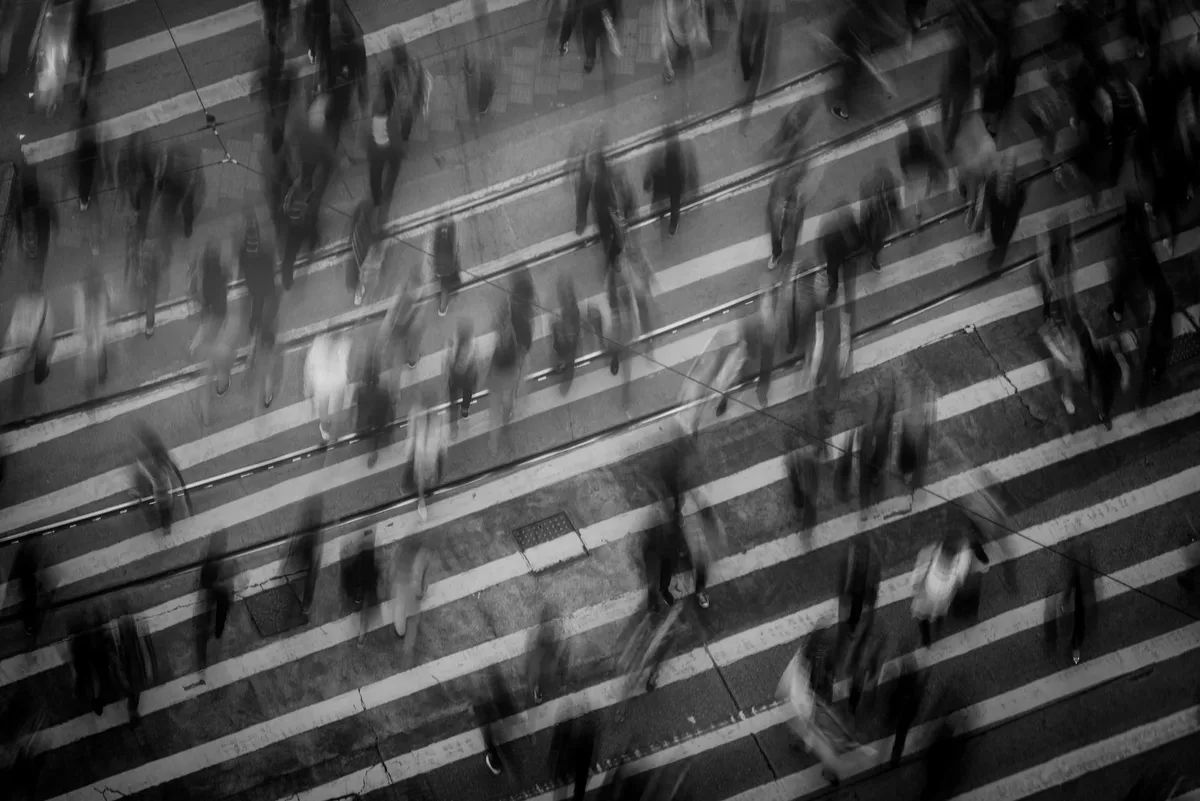
Cover photo courtesy of Mike Chai
Cristian Situ
Spain
About Cristian
Co-Executive Director and Founder of Sur Global, a nonprofit organization that promotes conscious innovation in Latin America. Master’s in Digital Management from Hyper Island. With more than 10 years of experience in innovation, digital design and project management, has worked in companies, consultancies and training. Was Education & Product Manager at Crehana and Head of Product at Colectivo23, leading educational projects with impact. Has collaborated as a consultant with UNICEF, Volvo, Peru’s Ministry of Education and Más Igualdad Perú, among others, always focused on design, technology and collaborative work to transform realities. Also Director of Communications and Publishing of UNTOLD.ink magazine.