sovereigntyExplore also: culture
Amazofuturism
A Brief Overview of Utopias in the Tropical Forest By Aliza Yanes Since the term was coined in 2019 to describe a movement in the visual arts that originated in Brazil, the concept of Amazofuturism has taken root in that country as a subgenre of science fiction literature and raises interesting questions: how is the future of this region conceived aesthetically, and who
A Brief Overview of Utopias in the Tropical Forest
By Aliza Yanes
Since the term was coined in 2019 to describe a movement in the visual arts that originated in Brazil, the concept of Amazon Futurism It has established itself in that country as a subgenre of science fiction and raises interesting questions: how is the future of this region conceived aesthetically, and who is (yes, even in the 21st century) the “true” Amazonian subject?
As Márcio Souza has already said: the Amazon—ever since that first unintended voyage in 1542, when Francisco de Orellana and his battered crew sighted for the first (and only) time the fierce, warlike beasts, which they named Amazonas— it is a region that seems to be in a constant state of “discovery”1. Since everything is a matter of perspective—depending on where you’re looking from—the Amazon can evoke a series of recurring and beloved images. From Europe, for example—or rather, from Berlin, where I live—people tend to associate it primarily (and almost exclusively) with nature, environmental issues, and indigenous struggles to preserve their territory.
There is no doubt that we are living in an era of technological advances, artificial intelligence, and constant changes in the way we experience and imagine the world. In May 2019, visual artist João Queiroz posted on his Instagram account (@q1r0z) a digital illustration depicting a scene never seen before. It shows a smiling young man with indigenous features, wearing a feather headdress, with a little monkey on his shoulder and a robotic arm, set against a landscape where nature and a futuristic vision blend harmoniously. Behind him, an Indigenous girl stares defiantly at the viewer. The landscape is a blend of bridges and futuristic structures intertwined with trees and vines. Also visible in the background is a man in a canoe, and in the distance, a large crowd gathered together—a community.
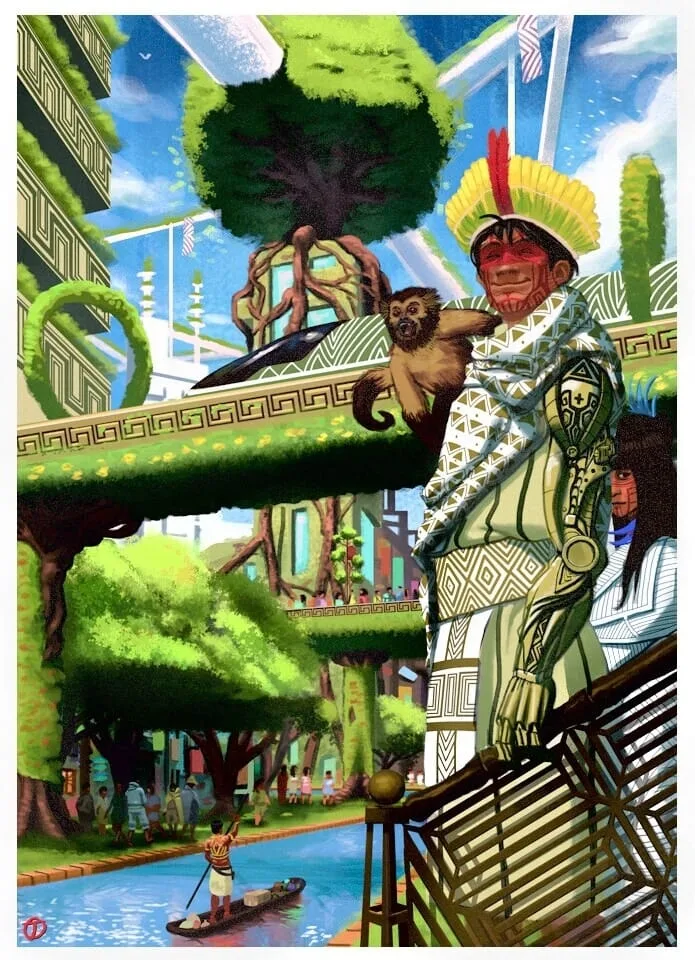
With this illustration, Queiroz ushered in “Amazofuturism,” a subgenre of science fiction in the visual arts, literature, and film that combines elements of Amazonian indigenous cultures with a vision akin to solarpunk, as it offers a positive portrayal of the symbiosis between ancient Amazonian cultures and technology.
In Search of Art from here
We observed that his main concern as an artist was to give his art a “local” feel, a sense of “this Brazil.” In that context, the use of the term stands out Pindorama, a word of Tupi origin—also found in Guaraní—that can be translated as “land of palm trees” or “land good for planting,” and which is believed to have been used by Indigenous peoples before the European invasion and colonization to refer to the territory we now know as Brazil. This latter name, imposed by the colonizers, is marked by a history of extractivism, as it derives from “pau-brasil,” the wood that the region primarily exported during its early colonial period.
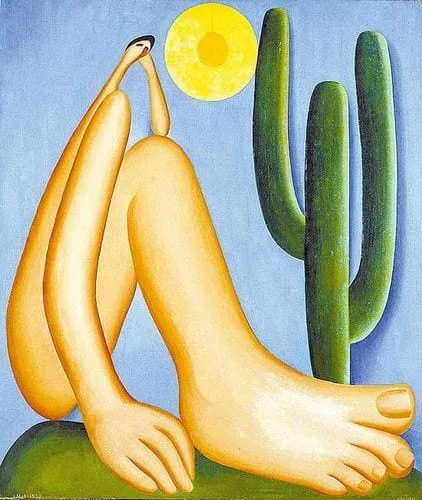
"Pindorama" is a term that was widely used by artists belonging to the Anthropophagic Movement, the most important artistic movement of Brazilian modernism—as the country’s avant-garde is known. The poet Oswald de Andrade had already outlined some of the most relevant points of the Anthropophagic Movement in his 1924 manifesto *Pau Brasil*, but it was in 1928, beginning with painting, Abaporu of his wife, Tarsila do Amaral, he finalized the definition and scope of the Anthropophagic Movement in his well-known Anthropophagic Manifesto. The goal, then, was to discover Brazil’s true artistic identity, with de Andrade’s dominant thesis being that Brazil’s history is one of “cultural cannibalization,” in which he chose the indigenous subject—and played metaphorically on the anthropophagy of which native peoples, such as the Tupinambás, were accused—as the central figure of anti-hegemonic resistance against European artistic imposition. “Tupi or not Tupi, that is the question,” de Andrade provocatively asked.
In Abaporu, The famous painting by Tarsila do Amaral that inspired the Anthropophagic Movement, depicts a human figure with a giant foot and a tiny head, accompanied by a cactus and a shining sun, reminiscent of 16th-century engravings of the fantastical creatures that supposedly inhabited the “New World.”
Legend has it that Oswald de Andrade came to identify as Brazilian while standing on a Parisian balcony and that, from that moment on, he sought to define Brazil’s true identity: an identity built on fusion, appropriation, and transformation, in which indigenous history and the indigenous imagination played a leading role. Now, nearly a hundred years later, it is once again the need to find a voice with a “distinct identity”—one closer to the “true Brazil”—that drove visual artist João Queiroz to create the Amazofuturist movement. We know that Queiroz was born in Rondônia, a state in Brazil’s western Amazon basin, and that he migrated to the south of the country as a child. He describes himself as an “indigenous person without a people” and asserts that he does not claim to project the future; rather, his work is a science fiction that deals with the present.
A Matter of Definitions and/or Definitions in Question
Amazofuturism, the new subgenre influenced by solarpunk—another science fiction subgenre that explores optimistic futures based on clean energy—set in the world’s largest and most diverse tropical rainforest, has not gone unnoticed by critics. In 2020, Vítor Castelões Gama and Marcelo Velloso Garcia published “Amazofuturism and Indigenous Futurism in Brazilian Science Fiction”, an article that distinguishes two genres within Brazilian science fiction associated with the Amazon region. According to the authors, while Amazofuturism is a subgenre of science fiction in which the Amazon and its indigenous peoples are portrayed in a positive light and in harmony with futuristic technology and nature, indigenous futurism focuses on indigenous visions of the future—and in doing so challenges colonialist constructs—and is, ideally, written by indigenous people themselves. It follows, then, that Amazofuturism, by contrast, does not necessarily have to be written by indigenous people.
The article is quite comprehensive and analyzes both images and texts created by contemporary Indigenous artists. An important section of the article discusses contemporary literary production in Brazil. Daniel Munduruku, one of the best-known and most prominent figures in indigenous literature in that country, maintains that there are currently 40 indigenous writers in Brazil—both men and women—from various indigenous groups who, in turn, work in a wide variety of literary genres.
But it is in the article “Where Does Amazofuturism Come From, and Where Is It Headed??" from 2021, in which the author, Vítor Castelões Gama, examines this term in greater detail. He considers that the most comprehensive—and therefore most widely used—definition to date is that of Rogério Pietro, a prominent and prolific Brazilian science fiction writer who, in 2020, published his first work in the genre, aptly titled Amazofuturism. It is part of a series that includes the novels Amazofuturism 1, Amazofuturism 2: Ancestral Spring and Amazofuturism 3: Native Power, in addition to Amazonian Warriors and The Living Amazon.
Pietro also published a manifesto in which he develops the principles of Amazofuturism. He asserts that in this subgenre, aesthetics is a form of knowledge and that in the Amazonian natural world—as its indigenous peoples teach—all lives matter. Hence, in Amazofuturism, the use of clean and renewable energy is focused on this very principle. The author notes that the goal is not to pay homage to indigenous peoples, but rather for non-indigenous people to learn to listen. For a literary work to be considered Amazofuturist—according to Pietro—it must meet the following five criteria: 1) The story must be about indigenous peoples (real or fictional) from the Amazon. 2) The indigenous peoples’ technology in the work must be innovative and unique. 3) Technological advances must be in harmony with the environment. 4) The story must be told from the perspective of the indigenous characters, not from that of explorers or scientists. 5) Amazofuturism is not about people; it is about life.
For Castelões Gama, who was born in Manaus, this definition has some problems: on the one hand, he considers the notion of “lost worlds” to be exoticizing, and on the other, he notes that this definition limits the region’s historical, cultural, and environmental complexity3. Pietro’s arguments seem to suggest that the only “Amazonian” nature is the upland forest and that the only “Amazonian” subjects are the indigenous peoples who inhabit it. Where, then—as Castelões Gama asks—do the urban areas, the “cultivated lands,” and the vegetation of the lowlands fit in? And what about the perspectives of the caboclos, the quilombolas, or the Islamic, Japanese, and Jewish communities present in the Brazilian Amazon?
Just a matter of fashion?
In recent years, Indigenous Amazonian artists have received greater attention on the international art scene, and previously inaccessible opportunities have opened up for them. In the case of Peru, the exhibition that marked a historic milestone was “The Green Eye: Amazonian Worldviews,” curated by Gredna Landolt and presented at the Fundación Telefónica Art Gallery in 2000, where, for the first time in the country, indigenous Amazonian works and paintings were exhibited as contemporary art. Today, more than twenty years later, indigenous Amazonian artists are exhibiting their work in different parts of the world. In 2025, in Spain alone and in conjunction with the Arco Madrid art fair, which was titled “Wametisé: “Ideas for an Amazonian Futurism,” curated by Denilson Baniwa, an artist from the Baniwa people of the Upper Rio Negro, and María Wills; there was Five Exhibitions of Amazonian Art. Among them were “Amazonías: The Ancestral Future” at the Centre de Cultura Contemporània de Barcelona (CCCB) and, in Madrid, “"Contemporary Amazonia: The Hochschild Correa Collection", curated by Christian Bendayán and Luis Pérez Oramas at the Lázaro Galdiano Museum.
The “Amazofuturism” of Arco Madrid 2025 is not the same as that of João Queiroz or Rogerio Pietro. In this case, the term is used as a concept rooted in the mythical image of the great creator serpent that appears in Wametisé, an oral tradition from the Upper Rio Negro region. In the words of Baniwa, quoted by Mayté Valencia in Amazofu (tourism) in Madrid4, The role of Amazonian indigenous peoples in contemporary art consists of contributing new terms and vocabularies to concepts “where art, nature, spirituality, and community are intertwined.”
The theme of “Amazofuturism” for Arco Madrid 2025 was widely discussed, drawing mainly questions and criticism about whether the Amazon and its representations are being used as a trend or whether their inclusion stems from genuine interest and commitment. Valencia herself wonders how to ensure that the presence of indigenous Amazonian art in venues like Arco is not merely an exoticizing trend, but rather leads to real changes in the protection of indigenous communities and territories. This would have to go beyond the possibilities of representation, circulation, and the employment and/or commercial opportunities secured for the indigenous artists participating in the exhibitions. Regarding Arco Madrid 2025, Valencia is emphatic in stating that “both the lecture series and the exhibition would have had a much greater reach outside of IFEMA. In the enormous venue, Wametisé "It came across as a pastiche embedded in a context that contradicted all the themes of the pieces, and seemed to condemn them to a folkloric and timeless aesthetic."5. Arco is, in fact, a trade show—a space designed to be consumed as an absolute and unquestionable expression of capitalism, where selling is the most important thing.
A Matter of Perspective and/or Perspectives in Action
The Amazon is a region unlike any other in the world, and the survival of its natural areas is key to the survival of the entire planet. Yes. It is also a region that has been generating knowledge for millennia. Indigenous knowledge, first and foremost, is the cultural heritage that allowed native populations to cultivate plants such as cassava—the staple of the Amazonian diet—and to inhabit a space where nature is in constant flux. With the European invasion and colonization, ancestral ways of life were destroyed, and texts began to be written and narratives constructed that—always from an outsider’s perspective full of prejudice—sought to define the region and its people. But by the 20th century, those colonial narratives began to be questioned, dismantled, and deconstructed. And today, there are many voices from the Amazon—in academic, artistic, and activist circles—speaking out to reflect on and share their own vision of History—with a capital “H”—which, to this day, remains intent on perpetuating a timeless representation of Indigenous peoples.
The exhibition “The Future Is Indigenous: Visions and Struggles of the Amazon,” which took place from October 2025 to March 2026 at the museum, was organized along these lines Rautenstrauch-Joest in Cologne, Germany. The exhibition, curated by Alfredo Villar, was conceived as a critical response to Sebastião Salgado’s photography exhibition “Amazônia,” which was taking place concurrently at that museum and had been criticized for presenting a static and timeless view of Brazil’s Amazonian indigenous peoples. In the words of Villar, the goal was to show “not the untouched Amazon of the past, but its urbanized present; not uncontacted indigenous peoples, but those who have assimilated and created their own forms of modernity; not the black-and-white vision of the great international artist, but the multicolored perspective of the indigenous photographers themselves.” It is worth noting that “The Future Is Indigenous” featured, in its largest exhibition space, the work of the renowned Shipibo-Konibo artist Olinda Silvano, titled Nii Kené (Forest of Designs).
Returning to Amazofuturism, both in the science fiction subgenre we’ve discussed and in the concept developed by Wametisé, the Indigenous subject takes center stage. I find João Queiroz’s work very interesting, and his artistic and identity-based exploration entirely valid. Moreover, he is not the only visual artist working in the genre; as Vítor Castelões Gama and Marcelo Velloso Garcia discuss in the article we’re reviewing, they analyze a series of images by young and very talented artists. Undoubtedly, Amazofuturist imagery reveals entire universes: referential echoes, invisible connections, and fictional horizons yet to be charted. I cannot comment on Rogerio Pietro’s novels because I have not read them; I only became familiar with his work when I began researching Amazofuturism. I do agree with Castelões Gama, however, that Pietro’s definition of Amazofuturism is arbitrary in that it proposes to represent only indigenous peoples, whether real or fictional.
The Amazon is indigenous, and the genocide and ecocide that began in the region in the 16th century have continued unabated, destroying the land, the waters, the wildlife, and the lives of the indigenous peoples and anyone who sets out to defend it: there are countless examples of activists who have been murdered. And the Amazon is not just indigenous; it is not just rivers and tropical forests. I wonder, then, if—in order to stop constantly “discovering” the Amazon, as Márcio Souza says—it might be worth stopping trying to see and represent it only as the space of nature and indigenous peoples, and rather to understand it in its reality real, deliberately emphasizing its diversity and complexity, its heterogeneity and multiplicity of voices. Voices that speak very loudly.
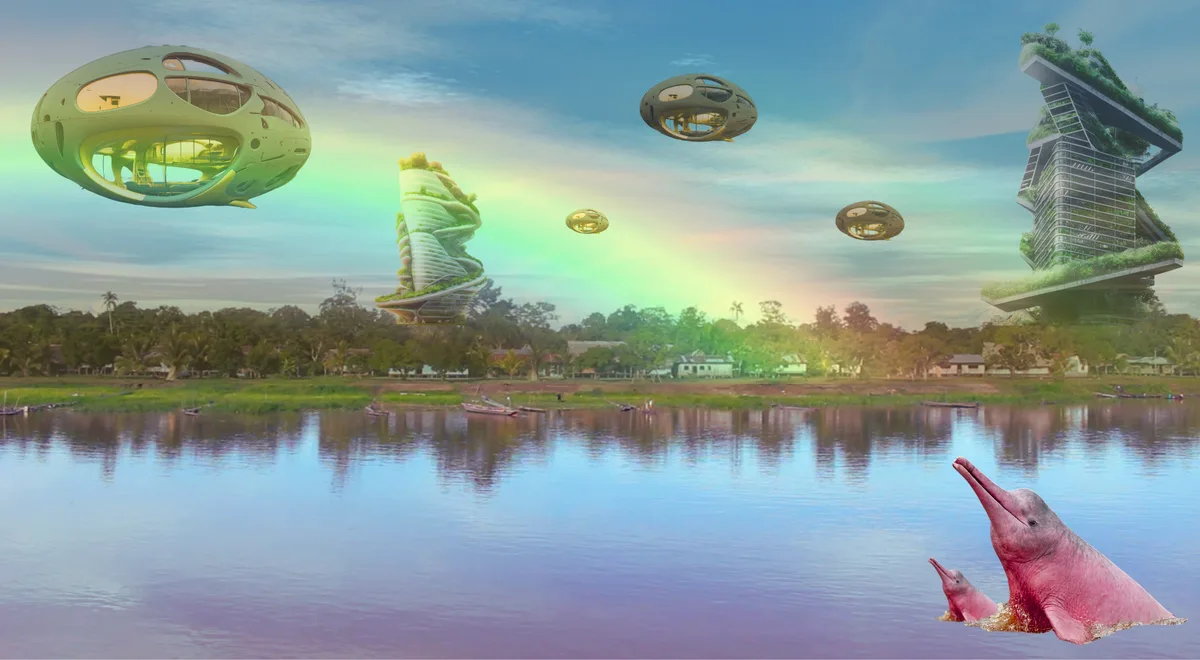
Cover image: "Amazofuturismo charapa" by Aliza Yanes
Aliza Yanes

Sobre Aliza
Aliza Yanes is from Lima and has lived in Berlin for ten years. She studied literature at the Universidad Nacional Mayor de San Marcos in Peru and earned two master’s degrees: Interdisciplinary Latin American Studies (FU Berlin) and Art in Context (UdK Berlin). In her artistic practice, she combines writing, art education, video, and performance. She develops participatory art projects for schools and youth groups that address social and political themes connecting the past with the present. Her strength lies in making academic topics in literature and colonial history accessible to the general public. She focuses on researching 16th-century discourses and narratives surrounding the mythical creatures of the so-called “New World.”
Tags:futures