artExplore also: sovereignty
The Sacred Ritual of the Here and Now: Speculative Rituals for Inhabiting the Interstice
A few months ago, I decided to leave my country to pursue a master's degree. After completing my bachelor's degree, weathering a pandemic, and navigating the fast pace of working life, I began to feel disconnected.
By Claudia Gallardo
I had lost sight of some of the ways of seeing the world that I grew up with, and that distance gradually transformed my routine into a rigid, almost meaningless structure. This new experience away from home thus became an opportunity to reconnect with my roots and explore their many interpretations. It was in the midst of that search that the project *The Sacred Ritual of the Here and Now* was born.
Beyond the Paranormal
I have a deep fascination with magic, spiritualism, past lives, and everything paranormal rooted in Peruvian folk narratives. I’m drawn to that blurred line between the visible and the invisible, the tangible and what is simply known—or what is attributed solely to “faith.” That’s why, when I was given the freedom to choose the topic for my “co-designing futures” project—a module in my master’s program—I knew I had to explore this aspect of my interests through the lens of social innovation. Even so, I knew I couldn’t approach it from a strictly academic perspective; I also needed it to be sensitive and rooted in my own memories.
So I was faced with a huge and somewhat disorganized question: Where do we even begin when talking about death, memory, forgetting, archives, the unspoken, the untold stories, and the loneliness that so often prevents us from telling them?
During my undergraduate studies, I took classes in Modern Philosophy, and two of the concepts that left the deepest impression on me were the idea of the immortality of the soul and Plato’s theory of recollection as presented by Socrates. I was excited to revisit this knowledge, but I also paused. I remembered that I come from a part of the world where people had already been thinking about death, the soul, and memories long before other men from the Global North put those words on paper. So I decided to follow the red thread back to my own origins.
I explored how death is experienced in different worldviews across Latin America and found that in many of them—and in contrast to Descartes’ view—the soul does not separate from the body, nor from the earth, nor from time. In Andean thought, for example, “ser en-ayllu” means inhabiting a living tapestry where humans, mountains, animals, plants, and spirits coexist as intertwined threads: nothing exists on its own; everything co-emerges in relation to one another (Escobar, 2017). Escobar refers to this way of understanding the world as a relational ontology, where “nothing preexists the relationships that constitute it” (Escobar, 2017).
To die, then, is not to disappear, but to be transformed within that continuous web. Moreover, our practices of holding wakes, conversing with spirits, making offerings, or even cooking for those who have passed away are ways of keeping what “died” present and continuing to weave our realities together with them.
It was along that same path that I came across the ideas of Silvia Rivera Cusicanqui, whose perspective on time and memory further broadened my questions. In her view, time does not move forward like an arrow, but rather in a spiral: the past is not left behind, but rather returns and engages in dialogue with the present, as she points out:
“There is no ‘post’ or ‘pre’ in a view of history that is neither linear nor teleological, that moves in cycles and spirals, that charts a course while continually returning to the same point. The Indigenous world does not conceive of history linearly, and the past and future are contained within the present: regression or progression, repetition or moving beyond the past, are at stake at every juncture and depend on our actions rather than our words.” (Rivera Cusicanqui, 2010)
From this perspective, death does not interrupt time: it reconfigures it. Remembering is not about looking back, but about making space for what still breathes within us. It is not about reliving the past with nostalgia or healing wounds in order to move forward, but about inhabiting memory as a form of struggle. However, this is a demanding task for those who undertake it, one that depends on both internal and external factors.
Coping with Grief in Latin America
Latin America is a region marked by a long history of violence: armed conflicts, forced displacement, extractivism, drug trafficking, corruption, and so on. These realities, though diverse, share a common feeling: pain. They are painful not only because of what has been experienced, but also because they are often repeated. They keep us, as Silvia Rivera Cusicanqui would say, “in a colonized present,” where the effects of the past have not disappeared—they have merely mutated and changed their face. In this context, it is not necessary for a foreign power to take over the territory: the hierarchies and oppressions inherited from colonialism remain alive, reshaping our experience from within our own postcolonial societies (Cusicanqui, 2010).
Amid this wear and tear, how can one survive? Often, the only strategy is to disconnect from the pain, avoid it, and flee, because the system does not account for fragility: it demands success and resilience, even from those born without the bare necessities of life. And yet, that sense of powerlessness becomes almost inevitable when one views the world solely through the lens of “nation-state” politics: a vision that encapsulates structural conflicts within rigid frameworks—too complex to be transformed—and where people’s agency over their own realities is neutralized. In response, Rivera Cusicanqui (2018) proposes a powerful alternative: to reclaim Indigenous thought and language as a model for overcoming the crisis of colonialism. However, this is not about appropriating Indigenous culture or idealizing it as the essence of modern nations, but rather about making internal colonization visible, historicizing mestizaje, and valuing the memories that emerge from Cholo and Indigenous traditions (Rivera Cusicanqui, 2018). Recognizing ourselves in these genealogies—even if we do not feel entirely a part of them—could be a first step toward not surrendering our subjectivity to the cynicism of power and, instead, inhabiting the present with a critical memory.
From another hemisphere, but in a similar vein, come the words of Donna Haraway, who also helped me think differently about the persistence of pain: compost. In Staying with the Trouble, Haraway proposes a situated ethics that seeks neither cleansing nor a solution, but rather to work with what remains. Compost—that mixture of organic waste—becomes a metaphor for a possible life: where there was loss, there can also be transformation. But composting cannot be rushed. It requires time, moisture, patience, and above all, co-presence. It is, as she calls it, an act sympoietic: something that can only be done with others (Haraway, 2016).
I’ll stop here. Because talking about “composting grief” in this context is not a naive act. It’s not about romanticizing pain or turning injustice into a metaphor. It’s not about “letting go,” “moving on,” or “closing chapters,” as is often repeated in self-help discourse. Composting grief, on the other hand, is a way of being with it, of working through it patiently and with others, without losing sight of its structural causes. It is a practice of radical care that acknowledges both what hurts and what causes it, in order to open up the possibility that something else—something unexpected—might grow from it (Haraway, 2016).
The Ritual/Workshop as a Speculative Artifact
After journeying through these passages of insight and questioning, I was overcome with nostalgia and emotions I didn't know how to process. I could only come to terms with them through one of my favorite boleros: Taste of Me. This song has always moved me, but for the first time, I felt like it was speaking to me and inviting me to take action.
“More than a thousand years will pass—many more… I don’t know if eternity knows love… but there, just as here, you’ll carry… the taste of me on your lips.” – Eydie Gorme and Los Panchos
I decided to trust her. And I said: Of course! What if we use food as that space to remember, imagine, and make up for what’s missing? Ultimately, the taste of everything that hurts us—the unsaid, the lost, the lingering—is what we inevitably carry in our mouths, in our bodies.
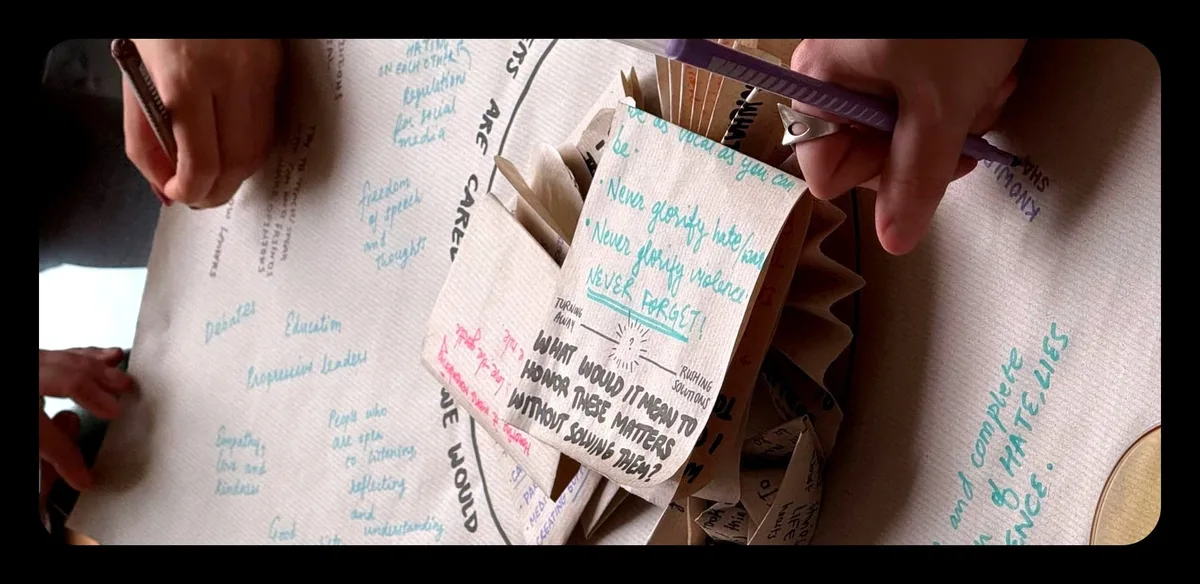
With that idea in mind, the "Ritual of the Here" was born—a speculative laboratory divided into two parts. The first activity, Recipes for Missing Ingredients, It was based on a culinary exploration of recipes with missing ingredients, in which we reimagined history beyond a linear narrative. Building on this, we selected the elements that would guide us into the second segment, in which we focused on collectively imagining how we might inhabit the “in-between,” acknowledging the complexity of what causes us pain without attempting to resolve it.
For “Recipes for Missing Ingredients,” each group was given a recipe that was missing a key ingredient. The ingredients were carefully selected for their sensory impact: garlic, tomato, salami… elements that leave a smell or stain, just like painful memories or voices that never made it into the archive. Next to each recipe was a card with questions to guide reflection: What ingredients might be missing? Why aren't they there? What would happen if we only cooked with what we could see?
The conversation began with food. We talked about flavors, textures, and how bland a dish can be without those elements. Each person imagined a different ingredient as the “missing” one, and no answer felt wrong. Although there was actually one ingredient omitted from each recipe due to the logistics of the workshop, what really mattered was how each person interpreted that absence.
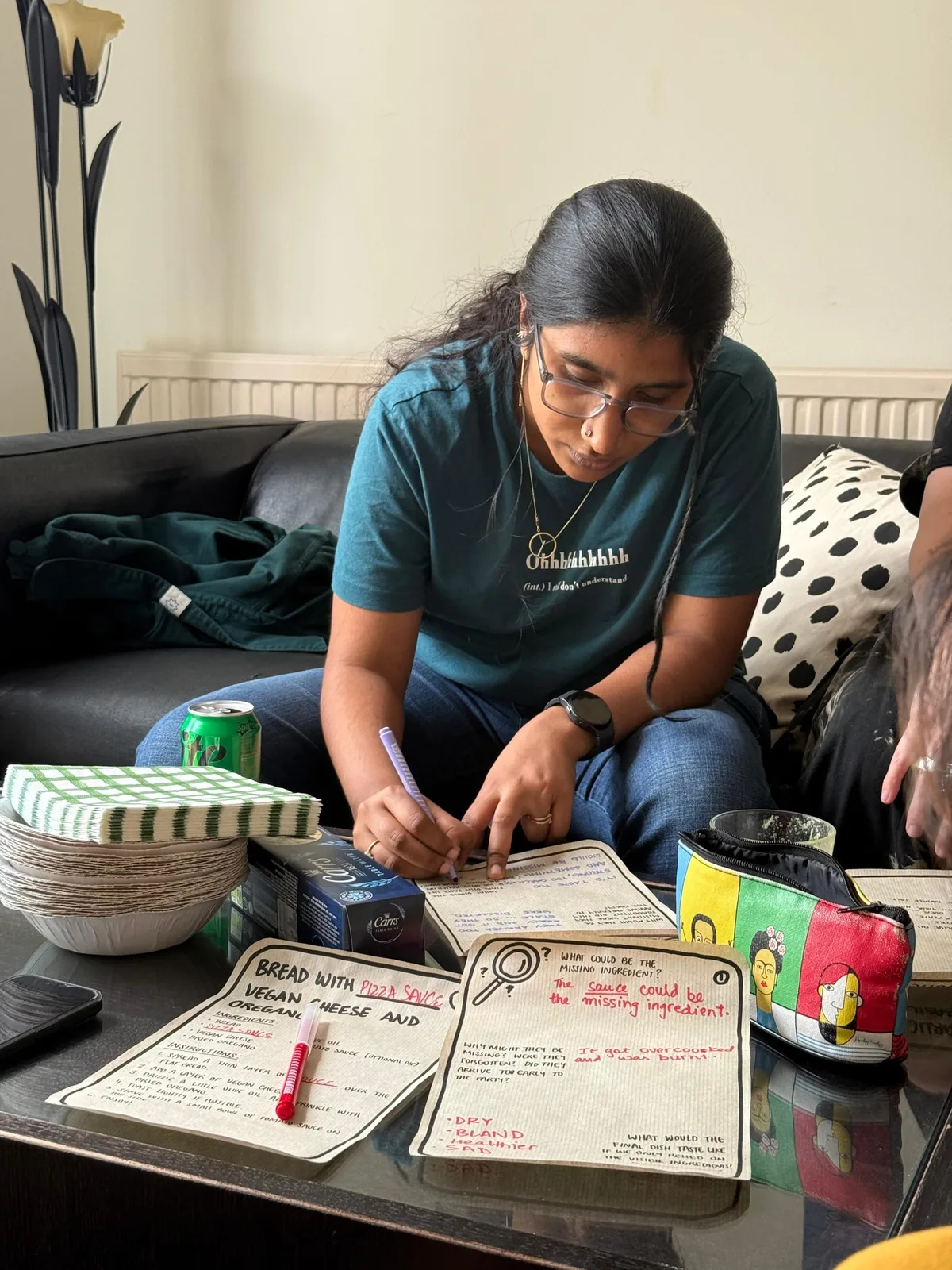
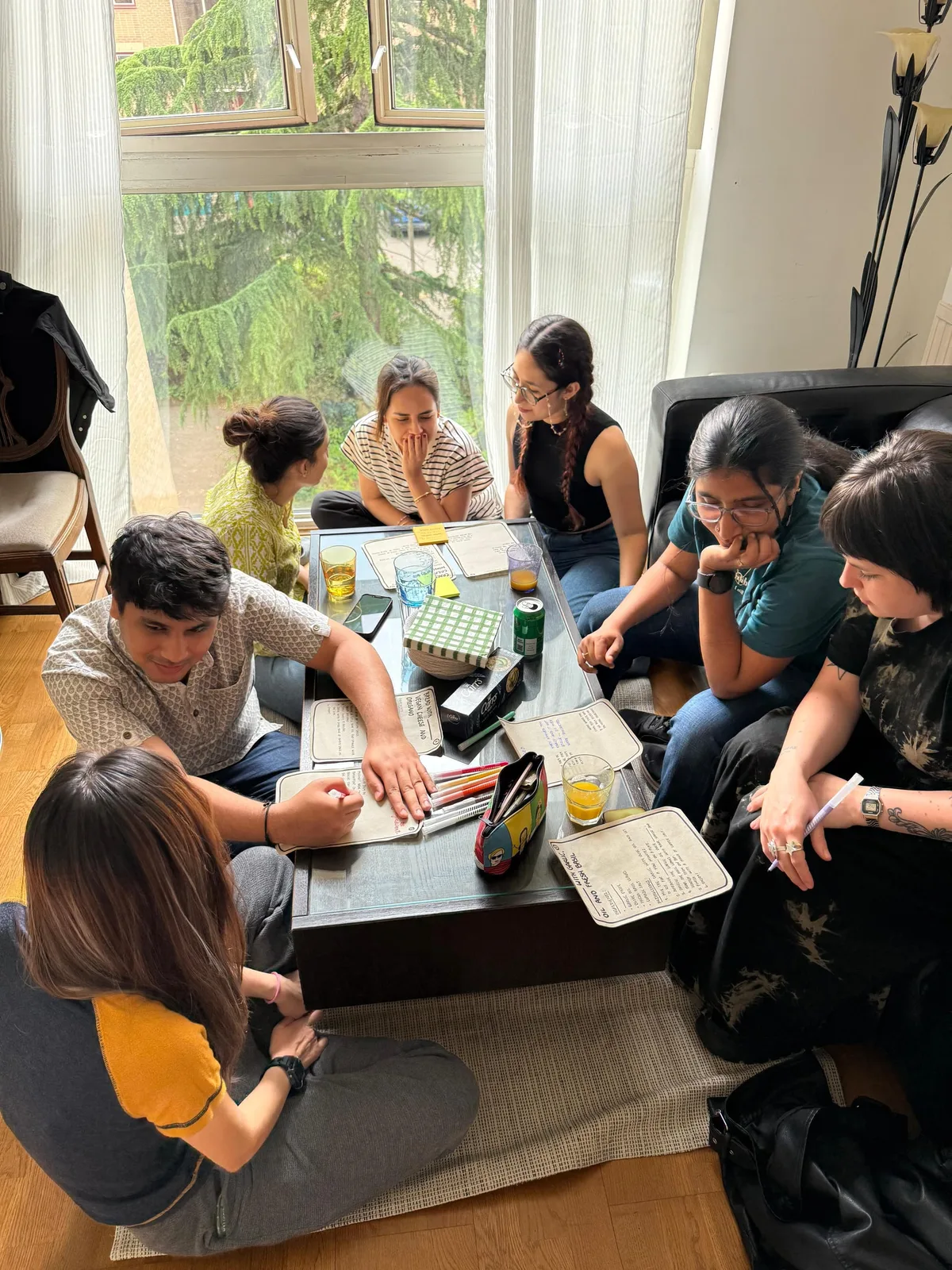
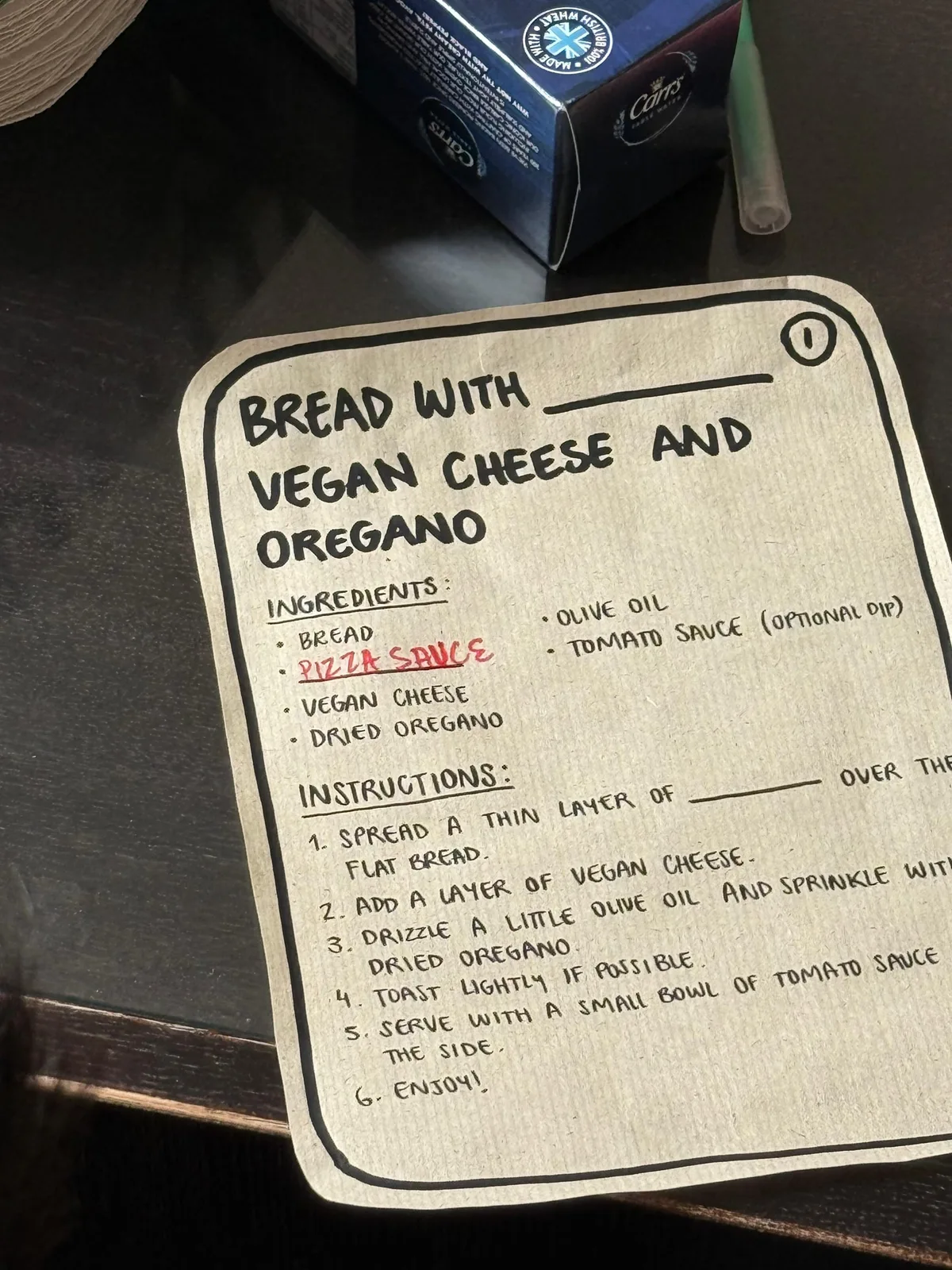
And so, through dialogue, we pose this question: What if we thought of recipes as our stories, and ingredients as those voices that are sometimes silenced?
Everything took on a whole new dimension: the incomplete recipes were no longer just playful exercises, but rather a representation of archives with gaps. The comparison worked because flavor is also memory. And because a story cooked up using only what’s visible may seem functional, but it leaves something to be desired… Like those recipes without garlic, without tomatoes, without that medley of flavors. In narrative terms, it’s like a story told solely from the “hero’s” perspective (Le Guin, 1986).
Then came the individual moment. Each person chose something that hadn’t been said, something that hurt, or something that had been silenced. I invited them to embody that missing element to bring it into the present and hold it in their hands, even if it wasn’t shared aloud. The space didn’t require exposure. If anyone wanted to speak, they were welcome to do so, but it was also okay to remain silent. Care, in this context, was a form of support.
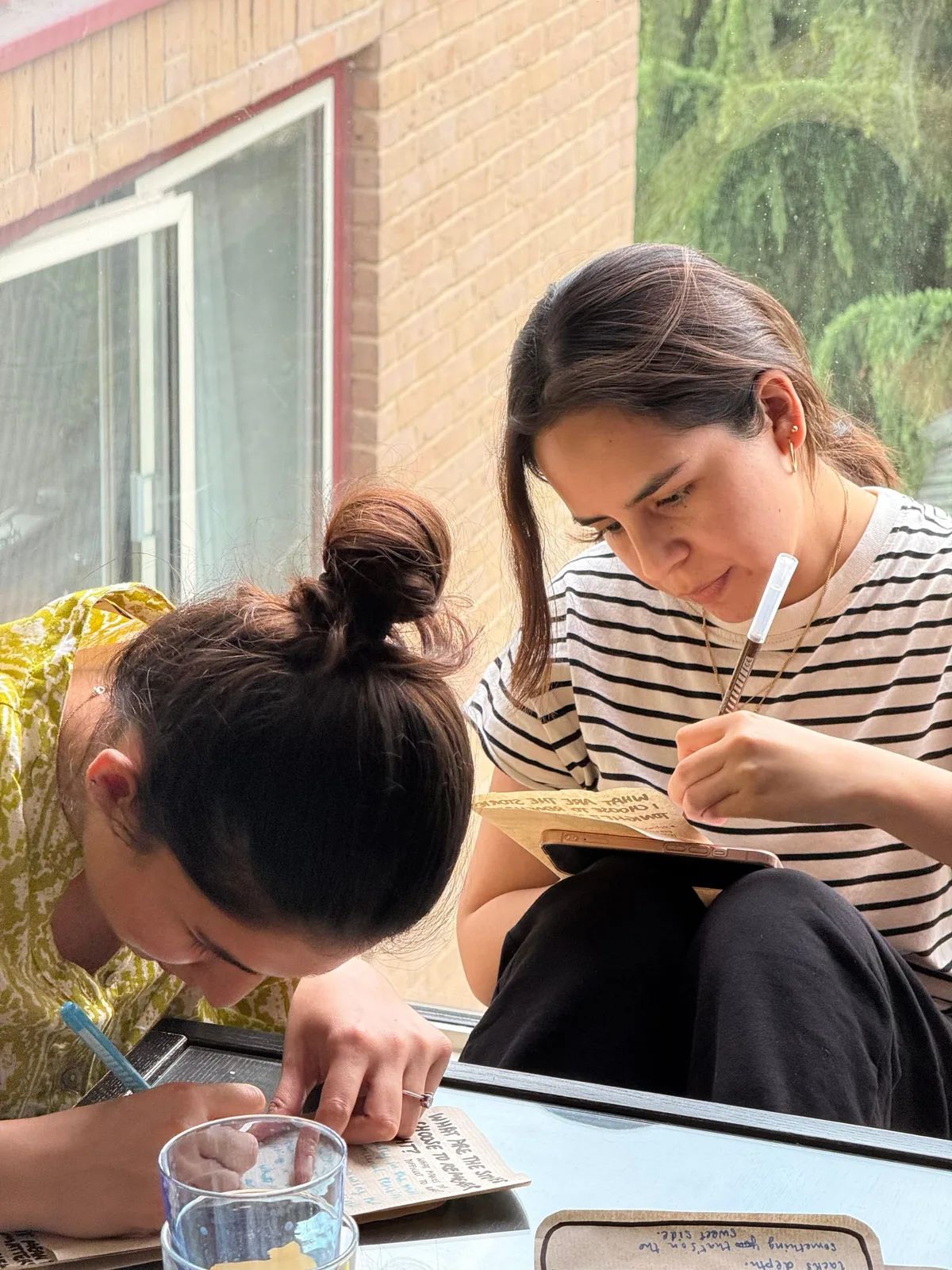
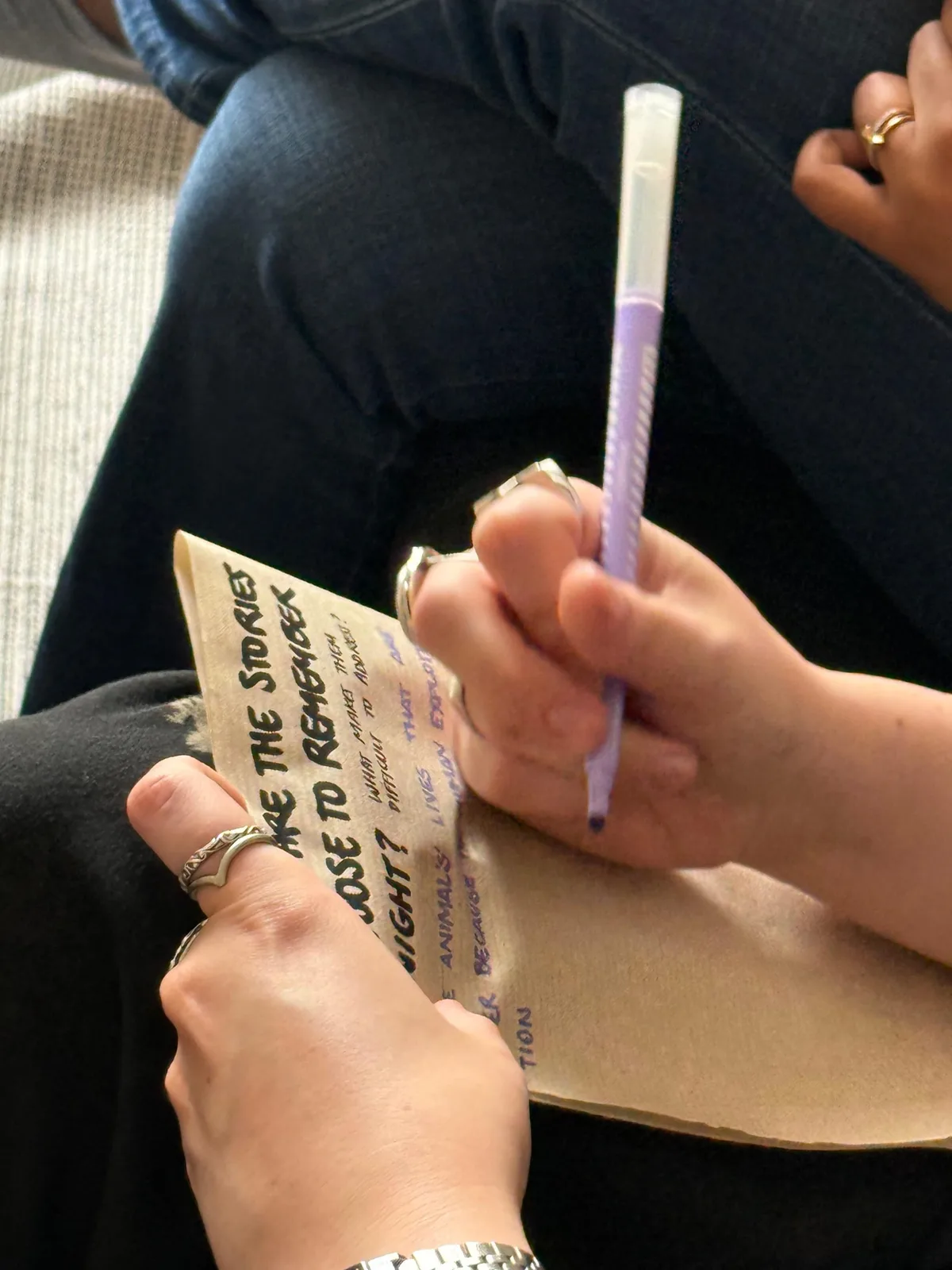
Afterward, we returned to the table to cook. We experimented with ingredients, new combinations, and reimagined versions of the recipes. It was a playful and intimate dinner. And without saying it outright, we remembered that history is also like that: a collective blend, a recipe in constant transformation. There’s always room for something missing, for something exchanged—and it’s always something that can be shared.
“And without saying it outright, we remember that history is also that: a collective blend, a recipe in constant transformation. There’s always room for something that’s missing, for something that’s exchanged, and it’s always something that can be shared.”
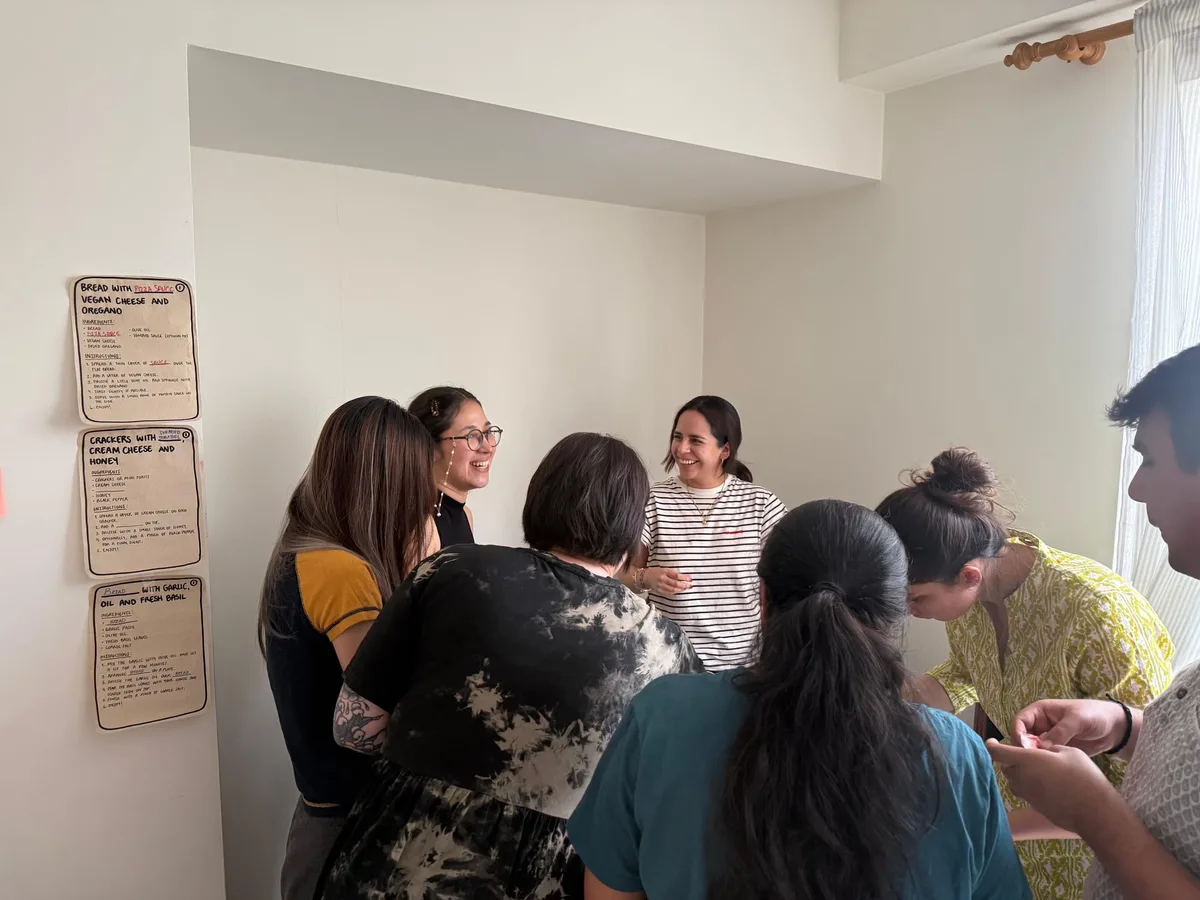
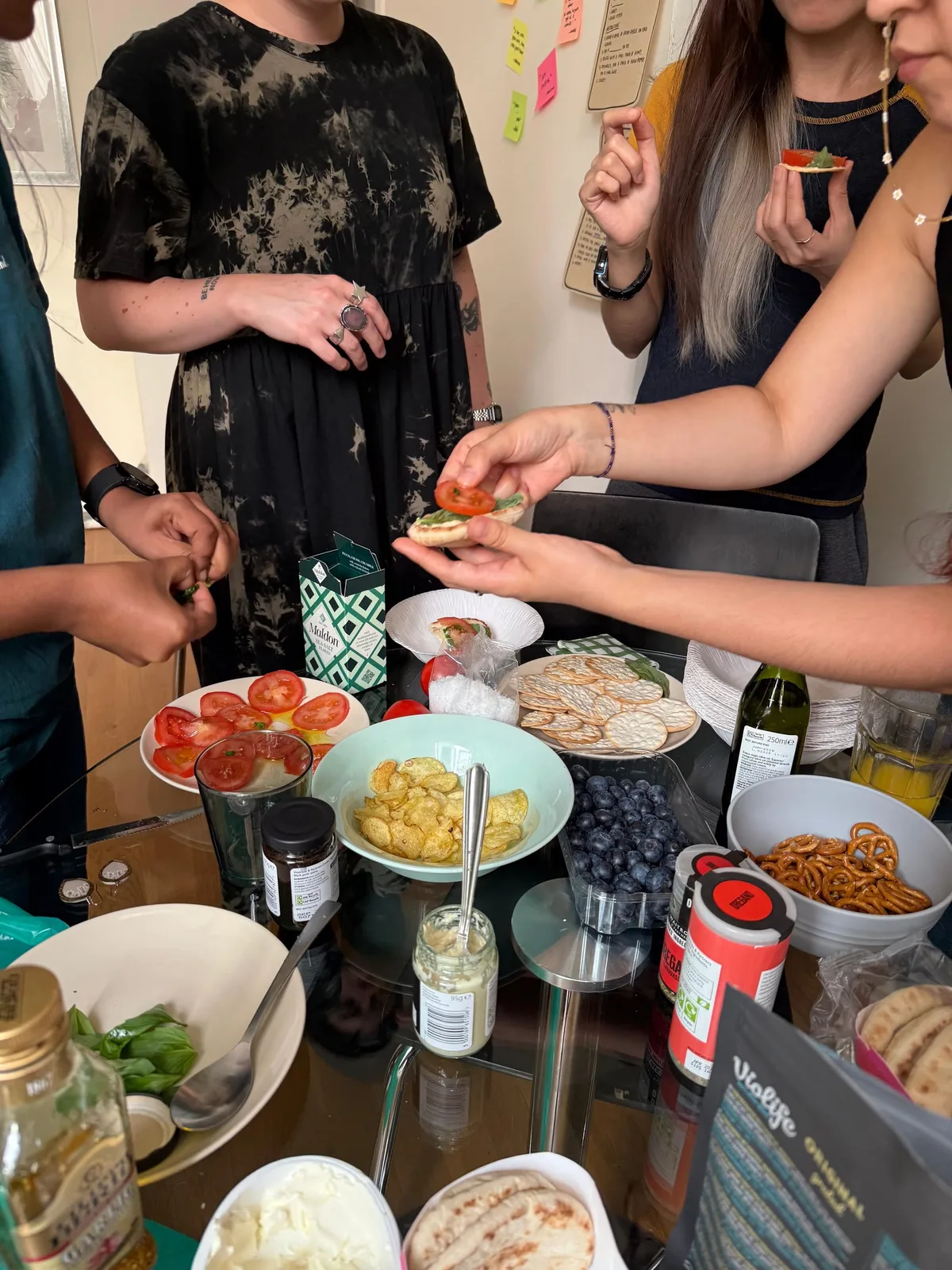
Finally, we brought the evening to a close by dwelling in that “in-between” space so often invoked by Rivera Cusicanqui (2018) and Haraway (2016). I invited them to pause and reflect on the conflict they had chosen, and to acknowledge the complexity of trying to “resolve” it. Not to resolve it or turn our backs on it, but to imagine—even if only for a moment—what it might mean to remain there, in that unstable space… without answers, but with all that it entails.
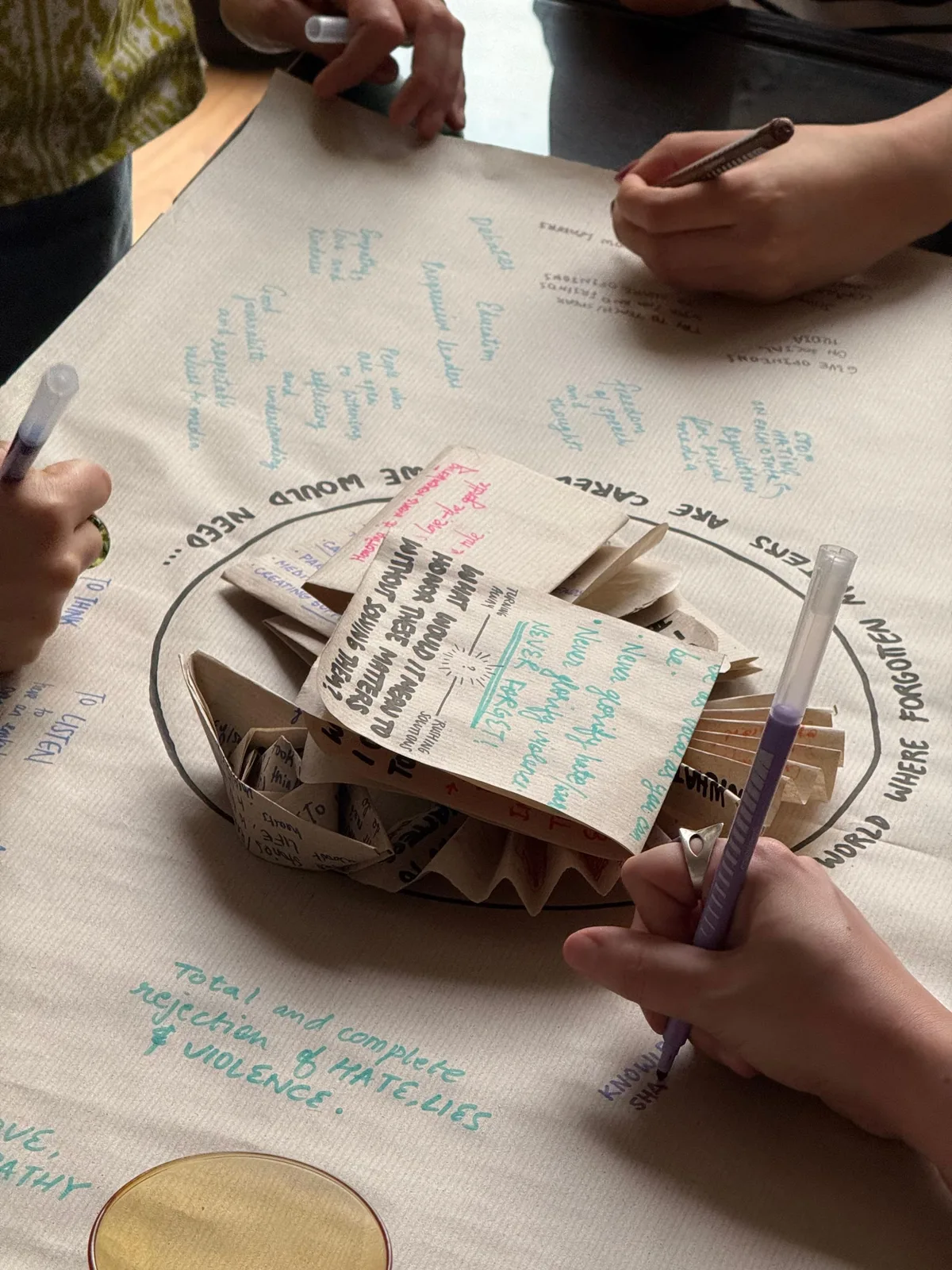
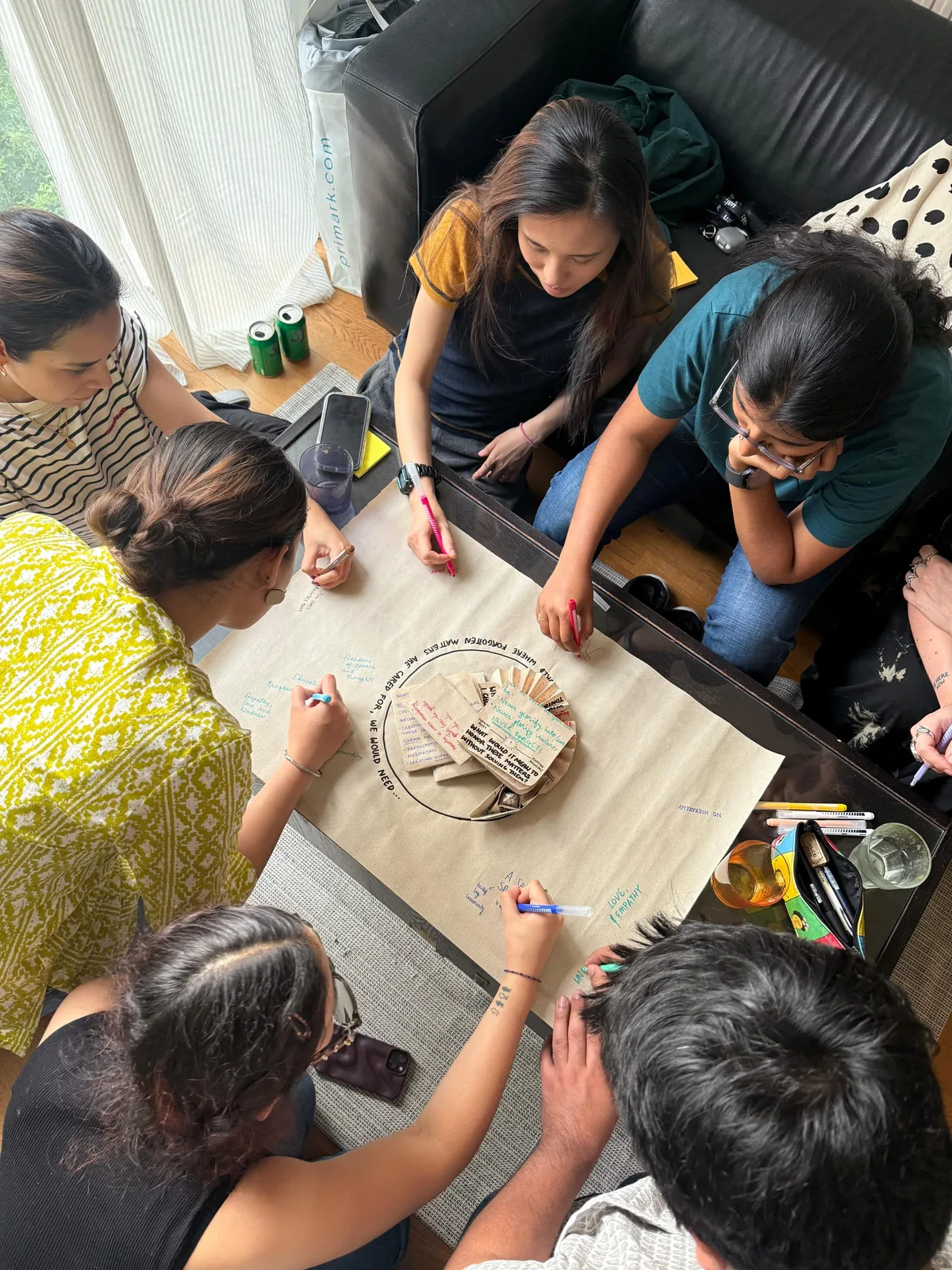
During that final moment of discussion, I noticed that, throughout dinner, we had created a space of trust even in the midst of uncertainty. Several of the participants felt encouraged to share their personal journeys. We spoke openly about our frustrations and pain, but we also fostered a sense of shared presence in our various struggles. For a moment, we created a space to work through them.
The end?
Rather than focusing on the impact it might have had or could have on other people, this project was, above all, an exercise in internal reprogramming. It was a way to question what I took for granted and to envision other ways of conceiving my universe based on my origins and my reality. Through The Ritual of the Here and Now, I chose to be present so that the ways of seeing the world that I developed as a child—but which were silenced over the years—would not die out. Today I know that I choose to live and die with them, responsibly and embracing constant compostability.
This ritual has no definitive conclusion, nor does it seek one: it continues as an evolving project that transforms with each new conversation or shared memory. I am interested in thinking of this practice not as a product, but as a form of affective and sensitive resistance to the systems that demand purity, efficiency, or resolution from us.
And I’m thinking especially of Latin America—more specifically, Peru. A country where the precarious state of the public system, misinformation on social media, and the state of emergency combine to create a sort of emotional anarchy, where no one seems to take responsibility… In this context, it becomes essential to keep imagining new—or old—ways of coming to terms with what causes us pain.
Because when we stop imagining, we surrender our reality to those who do. And often, those narratives imagined from positions of power do not include us or look out for us. That’s why, even though this project began as a speculation, I keep asking myself:
How could countries like mine learn to imagine living with pain, without romanticizing or denying it?
Bibliography
Escobar, A. (2017). Autonomy and Design: The Realization of the Communal (1st ed.). Tinta Limón.
Haraway, D. J. (2016). Staying with the Trouble: Making Kin in the Chthulucene. Duke University Press.
Le Guin, U. K. (1986). The Carrier Bag Theory of Fiction. In E. B. Marks & C. Courtivron (Eds.), The New Feminist Criticism: Essays on Women, Literature, and Theory (pp. 165–170). Pantheon Books.
Rivera Cusicanqui, S. (2010). Ch’ixinakax utxiwa: A Reflection on Decolonizing Practices and Discourses. Lemon Ink.
Rivera Cusicanqui, S. (2014). Myth and Development in Bolivia: The MAS Government’s Shift Toward Colonialism. Plural Editores and Piedra Rota.
Rivera Cusicanqui, S. (2018). A "Ch’ixi" World Is Possible: Essays from a Present in Crisis. Lemon Ink.
Claudia Gallardo

Sobre la autora
Claudia Gallardo Landauro is a Peruvian designer and artist who explores, through play and imagination, themes such as feminism, collective identity, and care—understood as means to co-create alternative realities. She holds a bachelor’s degree in Business Management from the Pontifical Catholic University of Peru and has worked in strategic design, most recently as a Senior Service Designer at Yape. She is currently pursuing a master’s degree in Design for Social Innovation and Sustainable Futures at the University of the Arts London.