artExplore also: decolonization
Cartographies of the Detour: Beatriz Ricci, from the South
"Cartographies of the Detour" could have been a Victorian game coined by Proust, but we will instead present it as a series of brief yet meaningful interviews that seek to balance critical acuity with human depth, always from—and for—the South.
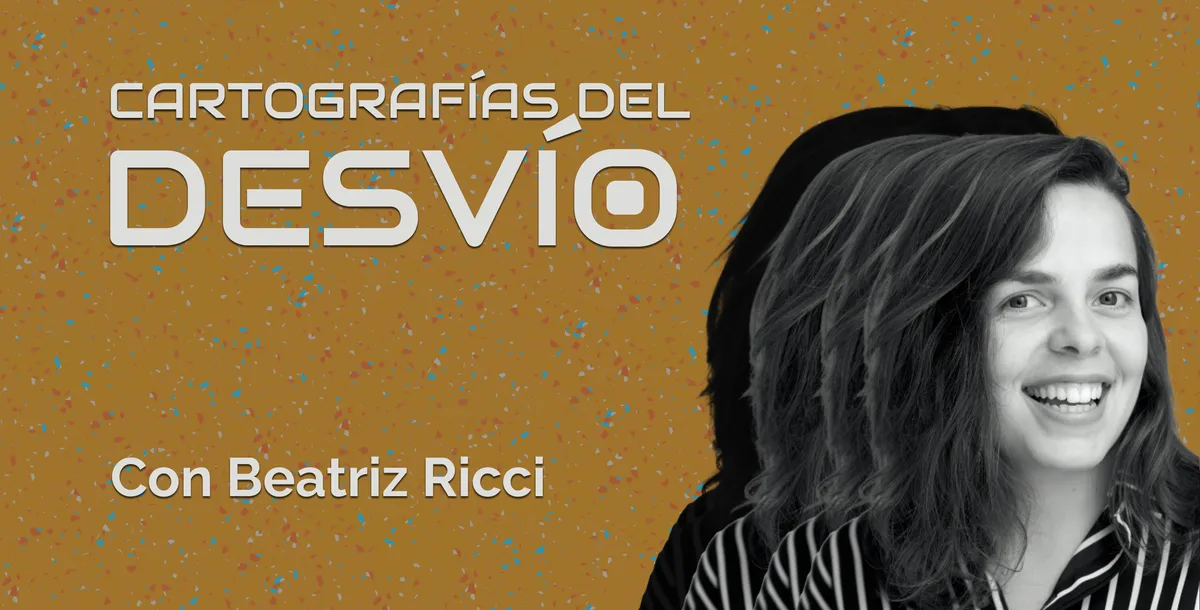
What does it mean to imagine from the margins? In this conversation, Beatriz Ricci answers our questions and reflects on how design can be a tool for justice and decolonization—from challenging the notion of progress to the role of big tech. Beatriz advocates for relational, situated, and collective design. Through her work, she seeks to challenge power structures, amplify silenced voices, and champion joy as a form of resistance. Drawing on her experience living between Brazil and Norway, and her place in the Global South, she advocates for a Latin America that is more united, critical, and compassionate.
What stories, people, or places have shaped your view of the future?
Indigenous artists, thinkers, and writers, as well as indigenists and Quilombolas such as Uýra, Ailton Krenak, Marisol de la Cadena, Silvia Rivera Cusicanqui, Nego Bispo, and so many others have profoundly shaped my vision of the future. These individuals imagine the unimaginable in the face of the existential crisis we are experiencing and invite us to reforest our minds and bodies. Their voices reveal what has been rendered invisible, break down binaries, destabilize patterns, decolonize languages, and reconnect us with the earth, the rivers, the animals, and the forests. They are invitations to recognize our plural identities and to understand that decolonization means acting politically, poetically, and collectively.
How do you understand the role of design and innovation in countries of the Global South?
Today, it is impossible to think about design and innovation without thinking about technology—and how it goes hand in hand with extractivism, consumerism, and misinformation. That is why I believe that the role of design and innovation in the countries of the Global South must be considered from a perspective of decolonization, sovereignty, justice, and solidarity throughout the entire process—not just in terms of interaction with the screen.
When we buy an electronic device, we rarely think about its supply chain. For example, our smartphones are made with minerals that, for the most part, come from the Congo. There, mining is controlled by militias that enslave and force women, children, and men to work for less than $2 an hour. These people often die in accidents and mine collapses. This process is financed by companies from the Global North—such as Microsoft, Apple, Dell, Tesla, and Google—which profit from the Congo’s political and social instability, a legacy of a violent colonial past.
I’m also concerned about—and focused on—how we’re going to withstand the advance of AI and big tech companies. These companies rely on large data centers that consume enormous amounts of water and electricity, which are needed to cool these systems. Today in Brazil, there are dozens of applications for permits to build these data centers in Ceará, a region that already suffers greatly from prolonged droughts and where thousands of families face water shortages.
As designers, we’re often responsible for creating the interaction between the user and their screen within an app. We need to keep the user engaged, using the product for as long as possible. That’s why, for me, the role of design emerging from the Global South must be to shift the perspective away from white, privileged Person-Centered Design and toward a Design for Justice, a Relational Design, in which we consider all the networks of relationships involved in that design.
Is there a question you're always trying to answer through your work?
How can we challenge and destabilize power structures to create a present and future that are more just, caring, and community-oriented?
What do you think is humanity's biggest misunderstanding?
I don’t think it’s a misunderstanding, but rather a very well-structured project: the idea of modernity and progress. For me, these two things underpin the monoculture of thought, being, and action. The myth of universality, which stems from this project, violently legitimizes our power structures that erase diversity and the collective.
This becomes even more evident when we link technology and progress. By depoliticizing design and technology, we reinforce that false universality: that single way of doing and imagining the world. I really like Cedric Price’s provocative statement: “Technology is the answer, but what was the question?” For me, technology is definitely not the answer, as our economic system insists.
And what about the biggest conspiracy?
I find it hard to talk about conspiracies. I find it hard not to view that word negatively, because today we’re facing very serious problems of misinformation and polarization around the world. To think about conspiracies is to think about the possibility of dubious consequences or the manipulation of the truth; it’s to feed into structures of hegemony or fears that I don’t want to cultivate.
My focus today is on reimagining possibilities. So I’m thinking about the arts of resistance, dreaming of different futures, and engaging in dialogue.
What conversations are still missing from the decision-making tables?
Decision-makers have access to information. That’s why I don’t think there’s a lack of dialogue; rather, there’s a lack of willingness to listen to the people who have the knowledge needed to address the crises we’re currently facing.
As indigenous leader Celia Xakriabá said: “We have the ancestral and social technologies to save life on Earth, but for that to happen, we need to listen with empathy. Rather than shouting, we must touch people’s hearts in a place where much is said but little is heard.” And I agree with her 100%. By the way, that excerpt from her speech was turned into a song: listen to “Brasil do Cocar.”
How can the practice of your profession challenge existing power structures?
When I bring in voices and ideas that broaden ways of thinking, they spark conversations, curiosity, and self-reflection. A large part of my practice involves facilitating conversations about how we designers also play a role as oppressors, and this reflection is a vulnerable and delicate journey.
I believe that when we confront that fear of examining all our facets—both as the oppressed and as the oppressor—that is when we can empower ourselves to challenge power structures, because we no longer fear looking at ourselves and can use our privilege to take action.
What risks are you willing to take at work today?
I've taken a few risks in recent years. I became a freelancer so I could be more selective about the types of clients I work with. I'm also part of a solidarity group with Latin America called LAG here in Norway.
In an academic setting, I speak up whenever I witness an injustice or Eurocentric and colonial discourse on the part of my professors.
I must also acknowledge my privilege as a white, upper-middle-class person. Today I live in a European country and have the opportunity to question, protest, and speak openly about my opinions. But I know that for many people, this can be risky, and that not everyone can take a stand because they have bills to pay. When I’m in Brazil, for example, it’s different. There are situations where I don’t speak openly about my gender identity or sexuality for fear of facing violence. So, it all depends on the context.
A book that made you change your mind
The Amazon: A Journey to the Center of the World, by Eliane Brum. This book opened my eyes to the violence committed by Norwegian state-owned companies against the peoples of the Amazon. There is a lot of talk about the Scandinavian countries as models of social welfare, and this book changed my opinion of those governments, their imperialist policies, and their indifference toward the Global South.
Norway is the largest donor of funds to the Amazon, and I find it very contradictory that that same country sends its state-owned companies to Latin America to illegally occupy indigenous territories in Peru, Brazil, and Chile.
I’m sharing this example because I’m currently living in Norway while writing my master’s thesis, and this was a piece of writing that moved me deeply and transformed my beliefs about my experience in this country. I moved here with expectations that were very different from the reality I encountered.
An idea you're leaving behind
Two things: perfectionism and a sense of urgency. To survive as an immigrant woman and a member of the LGBTQIAP+ community, I always felt I had to do more—and do it right away—to prove my worth. Today I realize that perfectionism is also a form of control, and that it stifled my authenticity and creativity.
A sense of urgency leaves us with no time to listen—neither to those around us nor to our own bodies.
A phrase that stays with you when everything is falling apart
Trust the process, trust yourself, and trust the people around you.
What question didn't we ask you that you would have liked to answer?
I always like to talk about joy, and to ask what joy means to each person. I shared some difficult experiences in this interview, and I believe that joy is closely linked to difficulties as well. To be joyful, we also need to be sad. Joy brings a vital energy that allows us to continue doing this work of questioning and finding new ways of thinking and living.
I think that in South America we spend a lot of time just trying to get by, and I would really like for us to be able to truly live as well. To do that, joy is essential.
If UNTOLD.ink were a constellation of people and knowledge, what role would you like to play?
It would serve as a bridge—a bridge between Brazil and Latin America. I think that, unfortunately, Brazil isolates itself too much from the rest of the continent. Perhaps because of the language, or perhaps because of the size of its territory and its sense of superiority.
My dream is to see a more united Latin America, and I would be very happy to contribute to this effort.
Beatriz Ricci

Sobre Beatriz
Beatriz is a multidisciplinary design professional and educator with more than a decade of global experience at the intersection of design, leadership, and culture. Her work focuses on creating immersive and experiential learning environments that empower individuals and teams to adopt diverse perspectives and drive cultural change. She collaborates with local and global organizations in sectors such as technology, education, social impact, and the creative industries. Her approach combines relational design methodologies with systems thinking to address complex challenges and build more equitable, community-centered futures.