UNTOLD.ink
Open the File: Emma Aiyin | Who Designed Womanhood?

3

In collaboration with SurGlobal / UNTOLD.ink

Open the File: Emma Aiyin | Who Designed Womanhood?

⏱ 58:14SurGlobal

What happens when a designer leaves one of the world's largest lingerie companies to rethink how intimate products are designed? In this episode of Open the File, I sit down with Emma, a designer whose career took her from the fast-paced world of commercial fashion at Victoria's Secret to founding Relief, a sustainable menstrual underwear brand that challenges the way we think about menstruation, health, and design. Together, we unpack the systems behind the products we wear every day and explore how design can influence not only comfort, but also sustainability, communication, and the way we experience our own bodies. This episode isn't only about period underwear. It's about questioning industries, redesigning systems, and understanding how thoughtful design can create meaningful change for people and the planet.

You might also like

Open the File | Adriana García: Memory and Displacement in Augmented Reality
48:22
Podcast★
Episode 548:22

Open the File | Adriana García: Memory and Displacement in Augmented Reality

In this episode of Open The File, Adriana García, a multidisciplinary designer and founder of AGar Estudio, opens her archives and shows us the entire process behind a very personal project: an Augmented Reality experience that documents the displacement of the community from the former San Mateo neighborhood in Cangrejos, now known as San Dulce Park in Santurce. Adriana takes us from research to execution: how she reached out to affected residents and families, her work with paper, wood, and illustration alongside AR technology, and the technical challenges of recreating homes and people who are no longer there. We also discuss memory, community, the role of art in the face of gentrification, and why “your neighborhood is next” remains a timely warning. A project born out of her digital art residency at the Puerto Rico Museum of Art (MAPR) and nearly 100 years of family history in Santurce. Why should you listen to this if you’re a designer? Because it’s a case study in how to combine multiple disciplines—branding, illustration, paper, and AR—in the service of a message, and how to make design decisions with ethical responsibility when the subject matter is sensitive: you’ll see firsthand the research process, community engagement, and technical execution behind a project that isn’t commercial, but rather one rooted in memory and community. And as always, ask yourself: What problem are you facing?

Open the File: Kevin King | Typographic Sovereignty
1:01:57
Podcast★
Episode 21:01:57

Open the File: Kevin King | Typographic Sovereignty

In this episode we sit down with Kevin King a typeface designer typographer calligrapher and type researcher based in Canada. After working at Toronto’s Coach House Press and Canada Type he completed his Master’s degree in Typeface Design with distinction at the University of Reading. His work focuses on font support and research for minority languages collaborating directly with Indigenous communities across North America. This isn't just a story about fonts. It's a story about infrastructure, about power, and about who gets to decide which languages can exist on a screen. We go into what nobody sees: the technical proposals to the Unicode Consortium, the negotiations with companies, and the decisions that can determine whether a language survives or disappears in digital space. Join us as we open the file and explore how typography can become a tool for cultural preservation language access and collective memory. Because what you see today is only one version of many. It is time to… Open The File.

1:29

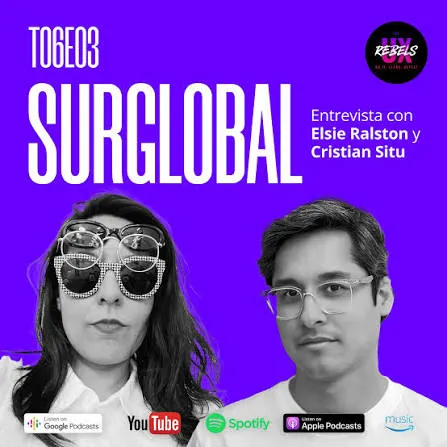
SURGLOBAL on The UX Rebels (Ep. 03, Season 6)

In this episode of The UX Rebels, we speak with Cristian Situ and Elsie Ralston, co-founders of Sur Global, a nonprofit organization that promotes more conscious and responsible innovation in Latin America. We discuss the origins of Sur Global, its purpose, and the educational model they’re using to train new generations of designers with a critical and locally grounded approach. We also reflect on the future of design in the region, the importance of rethinking the methods we were taught—methods that have historically been central to the world of innovation and technology—and the importance of adapting them to the contexts in which we are designing. We discussed the conference they’re organizing for October—a space where they aim to build community, learn collectively, and design from the Global South. A powerful, necessary, and urgent episode for those of us who believe that design has a social role to play in the world. And remember: we are rebels.

Newsletter

Ignite your curiosity, transform the future

Ideas and voices from the South in your inbox. Free, no spam.

We respect your privacy. Unsubscribe anytime.