artificial intelligenceExplore also: technology
An Uncomfortable Technology (Part I)
By Jorge Camacho Enthusiasm and Concern Surrounding Generative AI Some time ago, in November 2025, New York Times technology columnist Kevin Roose posted a comment on X about the widespread interest sparked by studies such as those from MIT and METR, which many people interpreted as evidence casting doubt on the impact of the first deployments of h
By Jorge Camacho
Enthusiasm and Concern Surrounding Generative AI
Some time ago, in November 2025, the technology columnist for the The New York Times, Kevin Roose, posted on X a comment on the widespread interest sparked by studies such as the folks at MIT and METR, which many people interpreted as evidence casting doubt on the impact of the initial rollouts of generative AI tools. He concluded his post with a peculiar statement:
Apparently—and perhaps rightly so—he was criticizing those who do not analyze these studies critically, which often leads to misinterpretations or exaggerated interpretations of the findings. However, for me, the most interesting question was: Why are people “desperate to prove that LLMs don’t work” in the first place?
In a similar vein, just a few days later, commentator Noah Smith published an article on Substack titled “I love AI. Why doesn’t everyone?”. In X He summed it up as follows:
In his article, Smith acknowledges some of what he calls “potential negative externalities” of AI, such as the deepfakes, the decline in critical thinking, the proliferation of low-quality content, or the risk that malicious actors will use AI to cause serious harm. However, he largely downplays these and other real or potential harms, arguing that negative attitudes toward AI are unfounded and irrational. Why? According to him, because such attitudes are based on a limited set of misleading or exaggerated claims about AI, such as its water consumption, its potential to concentrate wealth, or the risk of mass unemployment.
Toward the end of the article, Smith raises a question that closely mirrors the one posed by Roose: Why does a set of supposedly exaggerated or misleading claims about AI become so popular? He writes:
Thus, in a clear example of circular reasoning, we are told that people are averse to AI because they believe certain irrational claims, and that those claims are widely believed because people are averse to AI. Once again, the question remains: Why do people feel aversion toward AI in the first place?
These are just a few examples of AI enthusiasts facing a reality that is becoming increasingly apparent: most people, especially in the United States, don't like AI. By the end of 2025, both Politico such as the The New York Times They published articles exploring this phenomenon and acknowledging that this sentiment cuts across party lines, posing significant strategic challenges for both Democrats and Republicans.
These articles were based on recent surveys that showed widespread concern about AI in the United States. A report by the Pew Research Center, published in April 2025 It found that only 17% of Americans, compared with 56% of AI experts, believe that artificial intelligence will have a positive impact on the United States over the next 20 years.
This negative sentiment is particularly strong in the United States, but it is not unique to that country. Another recent Pew report found that, globally, “a median of 34% of adults say they feel more concerned than excited about the growing use of AI, while 42% feel equally concerned and excited.” In only two of the countries surveyed—Israel and South Korea—was the group that feels “more excited than concerned” (29% and 22%, respectively) slightly larger than the group that feels “more concerned than excited” (21% and 16%, respectively).
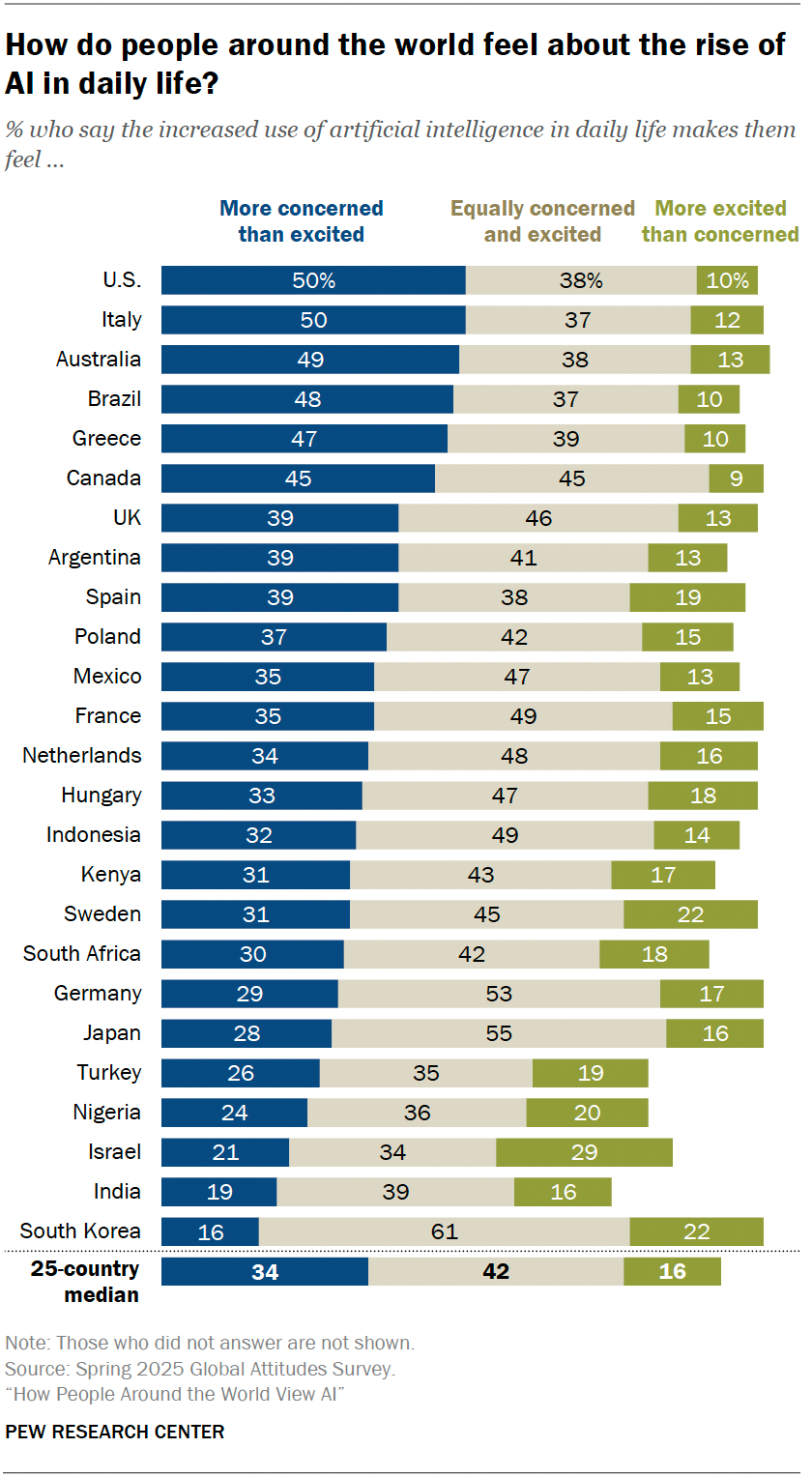
The survey is interesting for several reasons. One of them is the polarization it reveals—not only between those who are most concerned and those who are most enthusiastic, but also among the people themselves, who experience both emotions simultaneously. Many of us feel a kind of cognitive dissonance: if not exactly enthusiasm, then at least admiration for the capabilities of generative AI systems, accompanied by concern about their costs and potential harm.
It is also interesting that the survey uses “concern” and “enthusiasm” as indicators of acceptance of AI. They do not appear to be the opposite ends of the same spectrum, but rather the extremes of two distinct variables. However, the survey does not delve too deeply into the reasons behind these attitudes.
The first survey, which focused solely on the United States, does identify some specific concerns: potential job losses, public misinformation, a loss of human connection, and an increase in racial, ethnic, and gender biases through algorithmic decision-making systems. Most interesting is the distinction between the general public and “AI experts”—defined as people whose work or research is related to AI—and the divergence of opinions that this classification reveals.
If we look at both surveys together, it might seem that this divergence is correlated with—or even causally related to—the respondents’ familiarity with technology. Thus, so-called “AI experts”—that is, those who work directly with AI and are more focused on its technical aspects—show greater enthusiasm than the general public, which tends to take a broader view and be more concerned about its social consequences.
In fact, as I argued recently in a LinkedIn post, this tension between technical enthusiasm and social concern is evident in public discussions about AI. It could be argued that most writers, content creators, and influencers who are enthusiastic about AI focus primarily on the growing capabilities of these tools and on those who use them, rather than on their environmental, economic, social, and cultural costs and benefits. This can be seen in figures such as Ethan Mollick on LinkedIn, or Nate B. Jones on YouTube. On the other hand, most critics of AI—such as the journalist Karen Hao or the a team consisting of linguist Emily M. Bender and sociologist Alex Hanna— tend to focus more on systemic issues than on technical skills per se.
However, this hypothesis can become a bit more complex. Of course, AI enthusiasts also look at the economic, social, and cultural systems in which this technology exists. The difference is that, generally speaking, their perspective tends to be ideologically compatible with the status quo. Among other examples, one might mention Azeem Azhar, reporting from the World Economic Forum's annual meeting in Davos. In fact, these commentators may feel so comfortable with the current system that they end up focusing almost exclusively on the technical evolution of the technology.
Critics of AI, on the other hand, also consider technical capabilities, but they further analyze the systems within which those capabilities operate. More importantly, they tend to take a critical or oppositional stance toward those systems. A good example of this perspective is the constellation of technology-critical writers, podcasters, and scholars comprising Paris Marx, Brian Merchant, Edward Ongweso Jr. and Jathan Sadowski.
According to this hypothesis, viewing the big picture from a critical perspective profoundly influences how AI is assessed. This reminds me of a particular passage from Naomi Klein’s book *This Changes Everything*. Referring to Al Gore’s characterization of climate change as an “inconvenient truth,” she writes:
The story goes like this: two decades ago, when it was released Gore's documentary, it was already clear that climate change posed an enormous challenge to the capitalist system. More recently, the Network for Greening the Financial System confirmed that global economic growth could decline by 3% by 2030 due to climate change, while the the Institute and Faculty of Actuaries and the University of Exeter They warned that global GDP could decline by as much as 50% between 2070 and 2090. Given the magnitude of this threat, those who are satisfied with capitalism tend to view climate change as an inconvenient development and generally adopt one of two responses. One would be climate denial or delayism—that is, denying the reality or urgency of the problem. The other would be to acknowledge the problem without questioning the capitalism as the driving force behind it, which leads to superficial strategies such as carbon pricing or replacing conventional vehicles with hybrid or electric ones.
On the other hand, those of us who are critical of the economic system and believe in fairer alternatives may perceive climate change, paradoxically, as a politically convenient threat. Why? Because it can be seen as a definitive and unquestionable reason to drive profound transformations. Instead of seeking solutions within the system’s rules, this perspective favors proposals such as ecosocialism, which seek to combat climate change through a radical transformation of the economy. That is why, as Klein reminds us, the motto of the environmental justice movement is “Change the system, not the climate”.
Here we can find a kind of conceptual framework. Whether something is comfortable or uncomfortable—whether it’s a socio-ecological truth like climate change or an emerging technology like AI—depends on the relationship between three elements: the observer, the system, and the observed phenomenon. If you agree with the system and the new phenomenon is incompatible with it, you will find it uncomfortable. If you disagree with the system and the new phenomenon is incompatible with it, you will find it comfortable. This position is reminiscent of the old proverb: “The enemy of my enemy is my friend”. According to Klein, this is roughly how ecosocialism interprets climate change.
This framework can also be applied to AI. If you agree with the system and the new technology is compatible with it, you will find it comfortable: A friend of my friend is my friend. This would be the position of many AI enthusiasts, especially those in the tech industry, as well as the Donald Trump administration. Maybe that's why, as some have questioned, support for AI is often perceived as a stance associated with the political right.

But if you disagree with the system and the new technology is compatible with it, you'll find it inconvenient: The friend of my enemy is my enemy. As mentioned earlier, this is the perspective of many critics of AI and perhaps also of a large portion of that global majority that views the technology with concern. In fact, to complete the analogy with the discourse on climate change, some advocates of AI use the term “denialism" when referring to his critics, by explicitly comparing them with those who deny or delay climate action. However, it can be argued that these comparisons conflate critical stances with skeptical ones. For many of us, AI may be a real and highly capable technology, but it is politically uncomfortable because it threatens to perpetuate and even intensify the concentration of power and the harmful dynamics of our economic system.
How is it that AI is so compatible with the current system? Or, to put it more bluntly, why can it be considered capitalism’s best friend? That is the question I explore in the following sections of this essay. Before continuing, I will clarify some terminology.
Up to this point, I have used the vague term “AI,” a floating signifier par excellence. As argue Emily M. Bender and Alex Hanna, “AI” is essentially a marketing term “that does not refer to a coherent set of technologies.” Computer scientist and historian Thomas Haigh argues that a similar statement, perhaps a more precise one: “AI” is a brand. Like other brands, it brings together elements that are not necessarily connected to one another and attributes aspirational qualities to them. According to Haigh:
From this perspective, it is clear how the technology industry has benefited from the fact that the term “AI” suggests capabilities comparable to human intelligence. For this reason, the author argues, the term should be used more precisely to refer to a field of computer science research that remains, to a large extent, aspirational.
In this essay, I focus on generative AI, which embodies the evocative qualities of the broader concept. It could be defined as software applications and systems that use foundational models to generate different types of content: text, images, video, audio, and computer code. This includes widely used tools such as OpenAI’s ChatGPT, Anthropic’s Claude, and Google’s Gemini. In addition, I will take a broad and critical look at the AI industry, considering not only the tools themselves but also the companies, business practices, and the social and environmental context in which they operate.
In the second part of this essay, I will analyze the supply side of this industry, focusing on the tools and, above all, the human and natural resources they require. The third part will address the demand side: the supposed value proposition for consumers, organizations, and society at large.
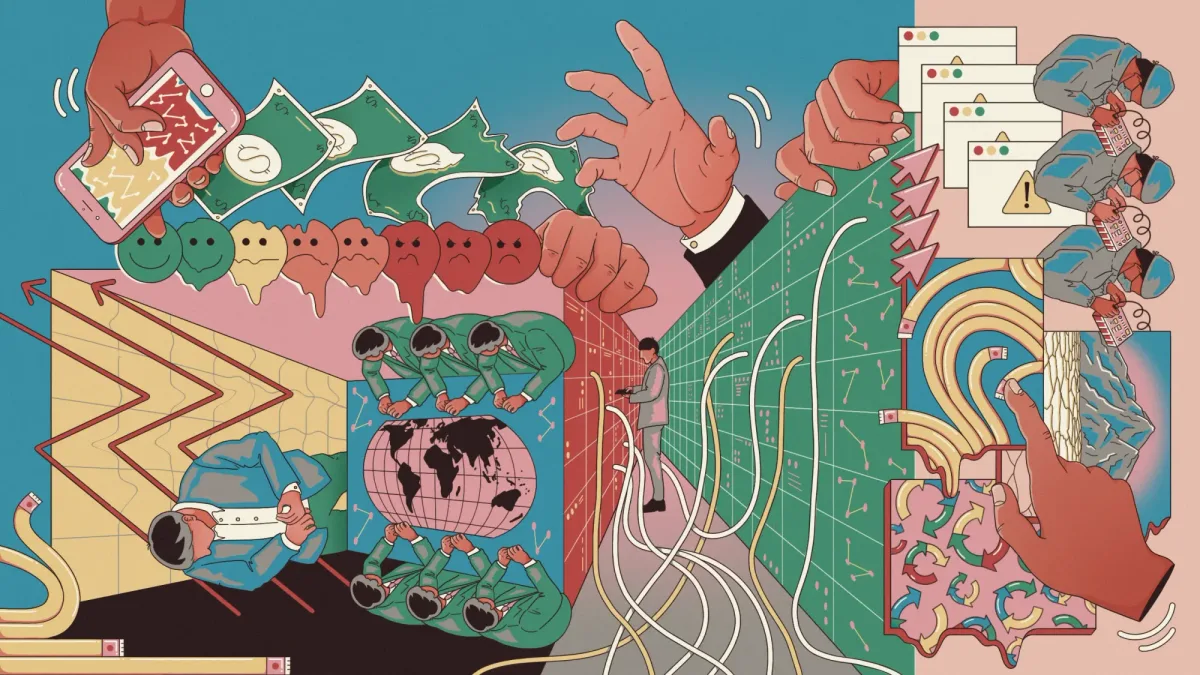
Cover image: Clarote & AI4Media: https://betterimagesofai.org / https://creativecommons.org/licenses/by/4.0/
This text was originally published in English on February 19, 2026, under the title "An Inconvenient Technology (Part 1): Excitement and Concern Surrounding Generative AI".
Jorge Camacho

Sobre Jorge
Jorge Camacho helps organizations design better futures for people. Jorge is co-founder of Diagonal Studio, director of the Master’s in Design program at Centro (Mexico) and a research affiliate at the Institute for the Future (IFTF).
Tags:Economyhype