artificial intelligenceExplore also: sovereignty
If it's free, you're the product
-By Elsie Ralston- From Television to the Algorithm Long before the “Like” button, before infinite scrolling, and before Silicon Valley turned the word “engagement” into a metric of power, American artist Richard Serra formulated an equation that has taken on absolute relevance in the digital age. In 1973, together with Carlota Fay Schoolman, he presented the video essay *Television Delive*
-By Elsie Ralston-
From Television to Algorithms
Long before the “Like” button, before infinite scrolling, and before Silicon Valley turned the word engagement In a "metric of power," American artist Richard Serra formulated an equation that takes on absolute significance in the digital age.
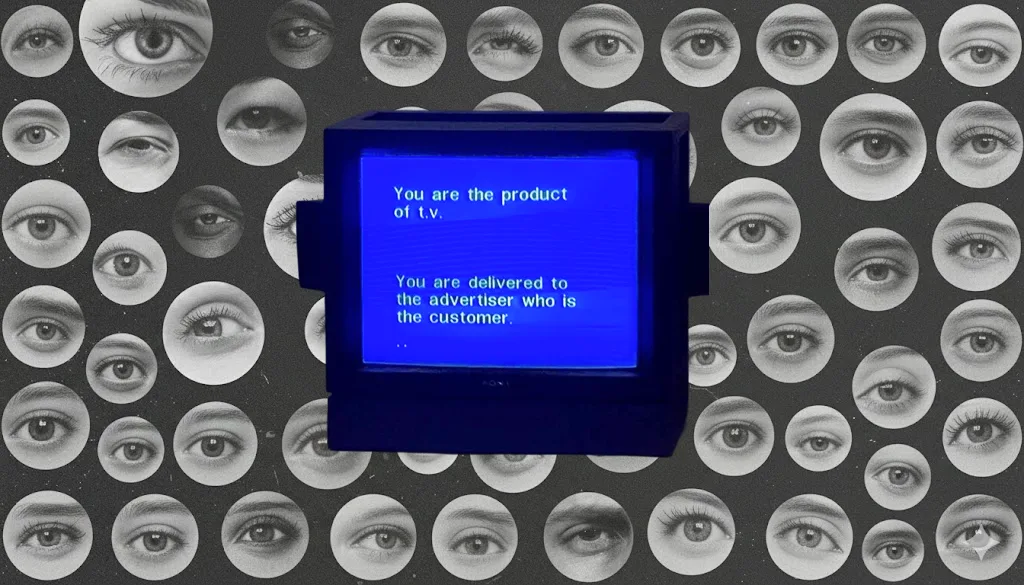
In 1973, together with Carlota Fay Schoolman, she presented the video essay Television Brings People Together. On a blue screen, in white text, a phrase repeated itself like an unsettling mantra:
You are a product of TV.
What Serra identified at the time was not a problem of content, but rather an economic structure: human attention turned into a commodity and the audience into raw material. “The consumer, consumed,” I would say.

Your privacy is the currency
Decades later, that logic hadn't disappeared. It had become more efficient.
In 20th-century television, the unit of value was the audience: ratings and programming schedules. The scale was massive but at the same time diffuse. In the 21st-century digital ecosystem, the unit of value has been refined, becoming profiled individuals. Today, every click, every pause, and every scroll feeds systems that not only display ads but also predict behavior.
The Center for Humane Technology, spearheaded by figures such as Aza Raskin, has pushed to shift the debate away from “problematic content” and toward the incentive model. In an episode of the “Possible” podcast, by Reid Hoffman and Aria Finger, Raskin raises an even more troubling point: businesses are no longer competing just for your attention, but for your privacy.
The engagement It's not just screen time; it's a race to occupy the most sensitive areas of the human experience. It's a win-lose: When a platform takes up our time and invades our privacy, something else will inevitably be pushed aside (whether it be relationships, rest, concentration, etc.).
Here's the crux of the matter: the problem isn't that there's advertising. The problem is that the system is optimized to maximize retention, regardless of which human aspects it must exploit to achieve that goal.
What Serra saw on television as audience engagement now functions as the extraction of predictability.
The Marubo Case: A Reflection of the Model
To understand that this is not a “cultural” phenomenon but a structural one, it is worth observing what happens when this infrastructure is implemented in different contexts.
In 2024, a article in The New York Times He described the arrival of Starlink satellite internet in communities of the Marubo people in the Javari Valley in Brazil. Connectivity brought immediate benefits: faster communication, access to information, and better healthcare coordination. But tensions also arose: young people spending long hours on social media, the rapid spread of rumors in chat groups, and intergenerational friction over how time is spent.

Some subsequent headlines distorted the story with sensationalist exaggerations—something that was clarified by independent fact-checkers—but the most important point wasn’t the sensationalism. It was the evidence that the engagement model is transferable. Thus, the Marubo case does not prove that “the internet destroys traditions,” but it does show that a system designed to capture attention will tend to compete with any other practice that requires sustained time: oral learning, collective rituals, conversation, etc.
What We're Aligning (and What We're Not)
In the same episode of the Possible podcast, another crucial idea emerges: we invest enormous resources in “aligning” artificial intelligence, but very little in aligning our collective intelligence—that is, our ability to coordinate socially to establish common boundaries, rules, and priorities.
We know that technology scales very quickly, but governance does not. And that has us stuck in a reactive loop: While the market and economies (whether national, corporate, or personal) optimize, society as a whole can only react. And this asymmetry explains why the attention economy can expand so seamlessly: the infrastructure is global, and deliberation is slow, fragmented, and sometimes nonexistent.
Regain Agency
This isn't about abandoning technology or idealizing isolation, much less turning every digital action into a source of guilt. But we do need to make a collective effort to understand the structure and propose alternatives.
When we download a “free” app, we’re participating in an exchange. It’s not always obvious, but it exists. And that exchange involves more than just data: it involves time, attention, and, increasingly, our privacy. Regaining our agency as users will mean asking ourselves what this platform is optimizing—and what part of my life it’s capitalizing on.
In this sense, resistance is very pragmatic. And it doesn't mean disconnecting from the world, but rather deciding more clearly to which world we want to be connected—and in what way.
If Serra’s art showed us the mechanism before it had a name, our task today is no longer to repeat the warning, but to redesign the system and ensure that technology adapts to our culture... A bit like the Marubo, who, after experimenting with unlimited connectivity, implemented their own limits and protocols so that this technology would not alienate their culture.
What's more, today it is no longer enough to simply point out that we are the product; we must ask ourselves what kind of leaders are allowing this to happen, and demand that they make effective changes to transform this reality.
Cover photo: Digital collage by Elsie Ralston; includes a photo from the video essay Television Brings People Together, by Richard Serra.
Elsie Ralston
Denmark

Sobre Elsie
A Peruvian strategist based in Copenhagen, Denmark. She has more than a decade of experience managing development and advocacy projects, and more than 8 years as a consultant in strategic design, digital product development, communications, fundraising, and public relations. She has worked with organizations in Latin America and Europe to advance initiatives in education, humanitarian response, financial inclusion, community empowerment, and, more recently, ethics and the responsible use of digital technologies. She is the co-founder and Executive Director of Sur Global, where she designs educational experiences and consulting projects that build learning communities committed to responsible innovation. She is also the Editorial Director of UNTOLD.ink magazine, which is dedicated to exploring new narratives about the future, territory, and knowledge.
Tags:technology